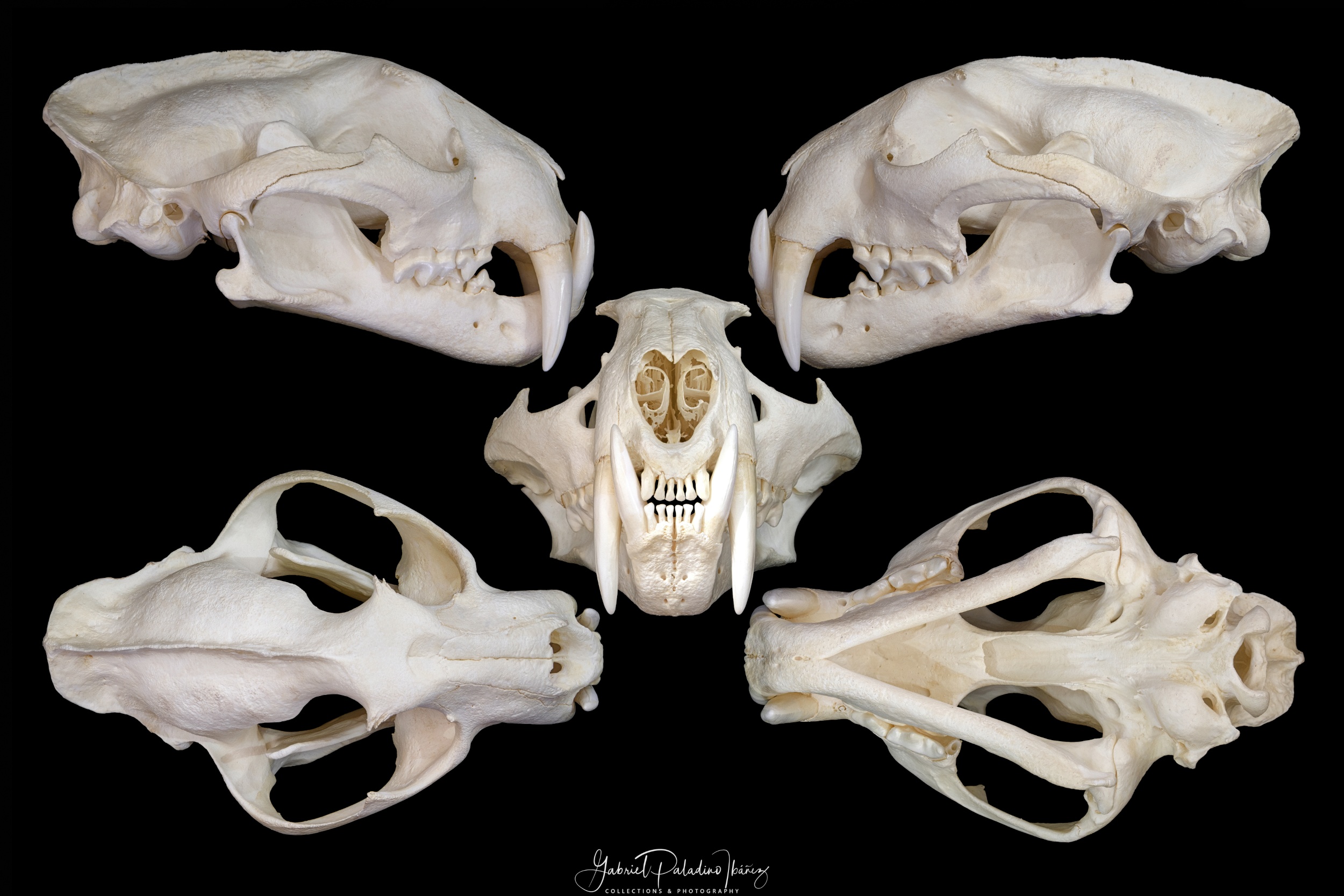
Native to the forests of mainland Southeast Asia, Neofelis nebulosa remains one of the least-studied big cats, and cranio-dental studies such as this offer valuable insight into its unique skull morphology.
This specimen, shown here from five angles — right and left lateral, dorsal, ventral, and frontal — illustrates one of the most distinctive traits in the living Felidae: relative to skull size, the clouded leopard has the longest upper canine teeth of any extant cat — a proportion that has long drawn comparisons to extinct saber-toothed predators such as Smilodon.
The rostrum is moderately elongated compared to other pantherines, providing space for the deep canine roots visible in the lateral profiles. Well-developed sagittal and nuchal crests anchor powerful temporalis and masseter musculature, producing an exceptionally strong bite force for the animal’s size — an adaptation that allows it to subdue prey considerably larger than itself.
The dentition follows the general felid formula, but the upper canines are dramatically hypertrophied: laterally compressed, finely edged, and disproportionately long relative to jaw depth. This forces an unusually wide gape, reflected in the shape of the mandibular condyle and coronoid process. The frontal view shows the narrow interorbital region and robust zygomatic arches, while the ventral view reveals a reduced postcanine dentition, with carnassials specialized for shearing flesh rather than crushing bone.
• Clouded Leopard
• Pantera nebulosa / Leopardo longibando
Scientific classification:
Kingdom: Animalia
Phylum: Chordata
Class: Mammalia
Order: Carnivora
Suborder: Feliformia
Family: Felidae
Subfamily: Pantherinae
Genus: Neofelis
Species: N. nebulosa
🧬 Replica specimen | size: approximately 19x12cm
Beyond its remarkable skull, Neofelis nebulosa is a highly arboreal cat, among the most agile climbers in the felid family. Exceptionally flexible ankle joints allow it to descend trees head-first, and its long tail — often as long as the body — provides balance while moving through the canopy. It hunts both on the ground and in trees, preying on deer, wild boar, primates, and birds. Elusive and largely nocturnal, it inhabits dense tropical and subtropical forest, where its cryptic, cloud-patterned coat provides effective camouflage. Habitat loss and fragmentation across its range have made it increasingly rare, and much of its ecology and behavior remains poorly documented in the wild.
Photo Taken: August 01, 2026
High resolution
Flickr Gallery