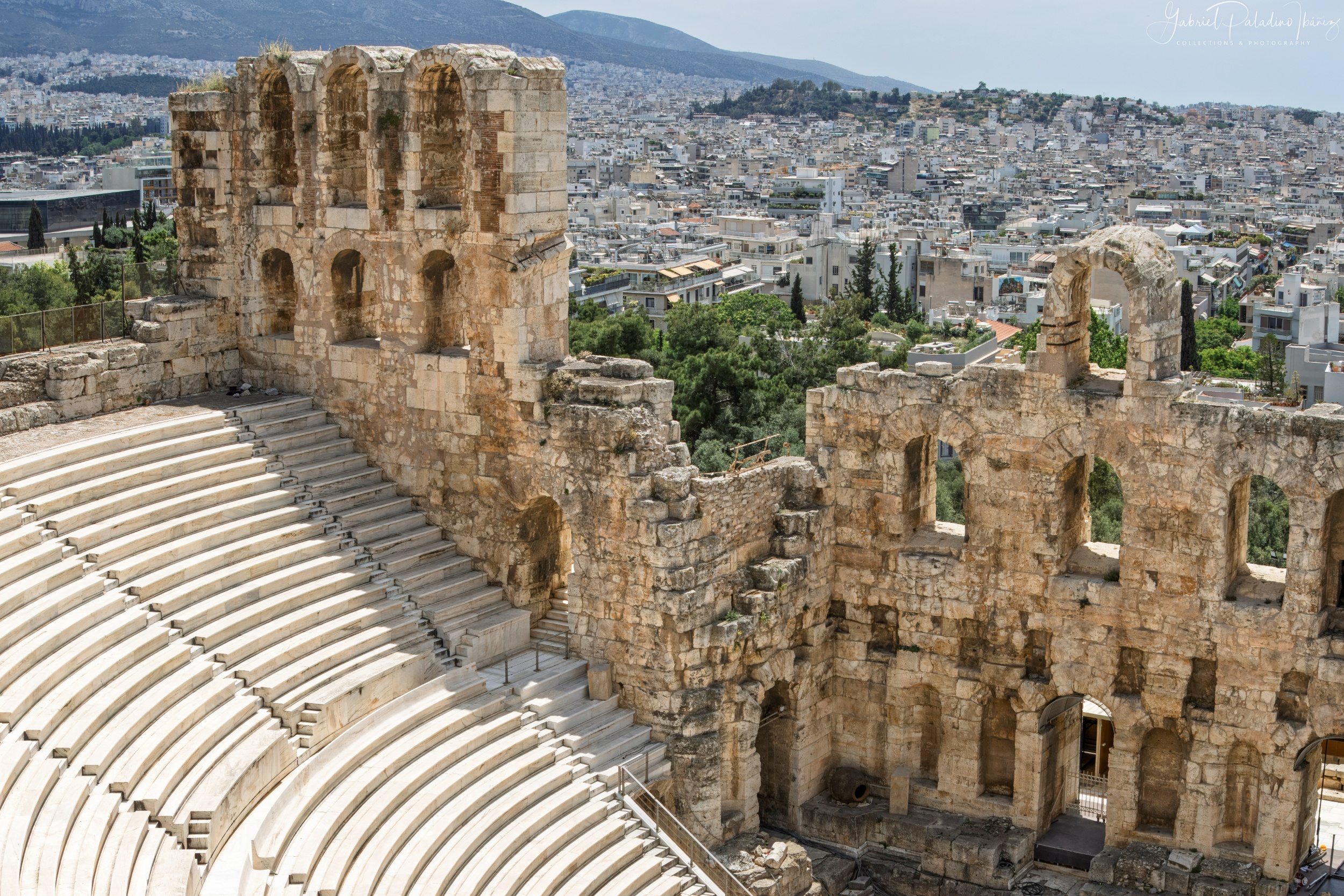
The Odeon of Herodes Atticus, Athens
The Odeon of Herodes Atticus, known locally as the Herodeion, is a Roman-period theatre built into the southwest slope of the Acropolis in Athens. Construction began around 161 AD, commissioned by Herodes Atticus, an Athenian rhetorician, philanthropist, and Roman senator who tutored the future emperor Marcus Aurelius. The building was completed by 174 AD, when the traveler Pausanias described it in its finished state as the finest structure of its kind. Herodes dedicated it to his wife, Appia Annia Regilla, a Roman aristocrat related by birth to several imperial families, who had died the previous year. Ancient sources record that her brother accused Herodes of having ordered her killing, though he was acquitted, reportedly through imperial intervention. The exact circumstances of her death remain disputed among historians rather than definitively established.
Architecturally, the Odeon was the third such structure built in Athens, following the Odeon of Pericles (5th century BC) and the Odeon of Agrippa (15 BC), but distinguished by Roman construction techniques. Unlike open-air Greek theatres, it was fully roofed. The semicircular cavea, carved from the hillside, had a diameter of 80 meters and originally held around 5,000 spectators, though seating today, following 20th-century restoration, accommodates 4,680. The stage building, faced in white marble and cipollino stone, measured 35 meters in length, with a scenic wall rising to 28 meters across three stories, decorated with arches, columns, and statue niches. The roof, spanning a radius of about 38 meters, was built of cedar of Lebanon without any internal supports—an engineering achievement still regarded as remarkable today, since no trace of supporting structures has ever been found.
The Odeon was destroyed in 267 AD during the Heruli invasion of Athens and, unlike other damaged buildings of the city, was never rebuilt in antiquity. It lay largely in ruin through the following centuries. Systematic excavation began in the mid-19th century under archaeologist Kyriakos Pittakis of the Archaeological Society, clearing substantial accumulated debris. Major restoration using Pentelic marble took place in 1952–1953, and the theatre reopened for performances in 1957. Since then it has served as the principal venue of the Athens Festival, held annually between May and either September or October depending on the year, and has hosted a long list of internationally known performers and events, including the Miss Universe pageant in 1973. According to recent reporting, the theatre is expected to close for restoration for at least three years following the 2026 festival season, though this has not been independently confirmed beyond the initial source.
Acropolis of Athens, Athens, Greece

Camera: Canon EOS R7
Lens: TAMRON SP 28-75mm F/2.8 Di A09E
Capture Information:
Focal Length: 28.0 mm
Shutter Speed: 1/640
Aperture: f/8.0
ISO: 125
Photo Taken: May 19, 2026
High resolution
Flickr Gallery