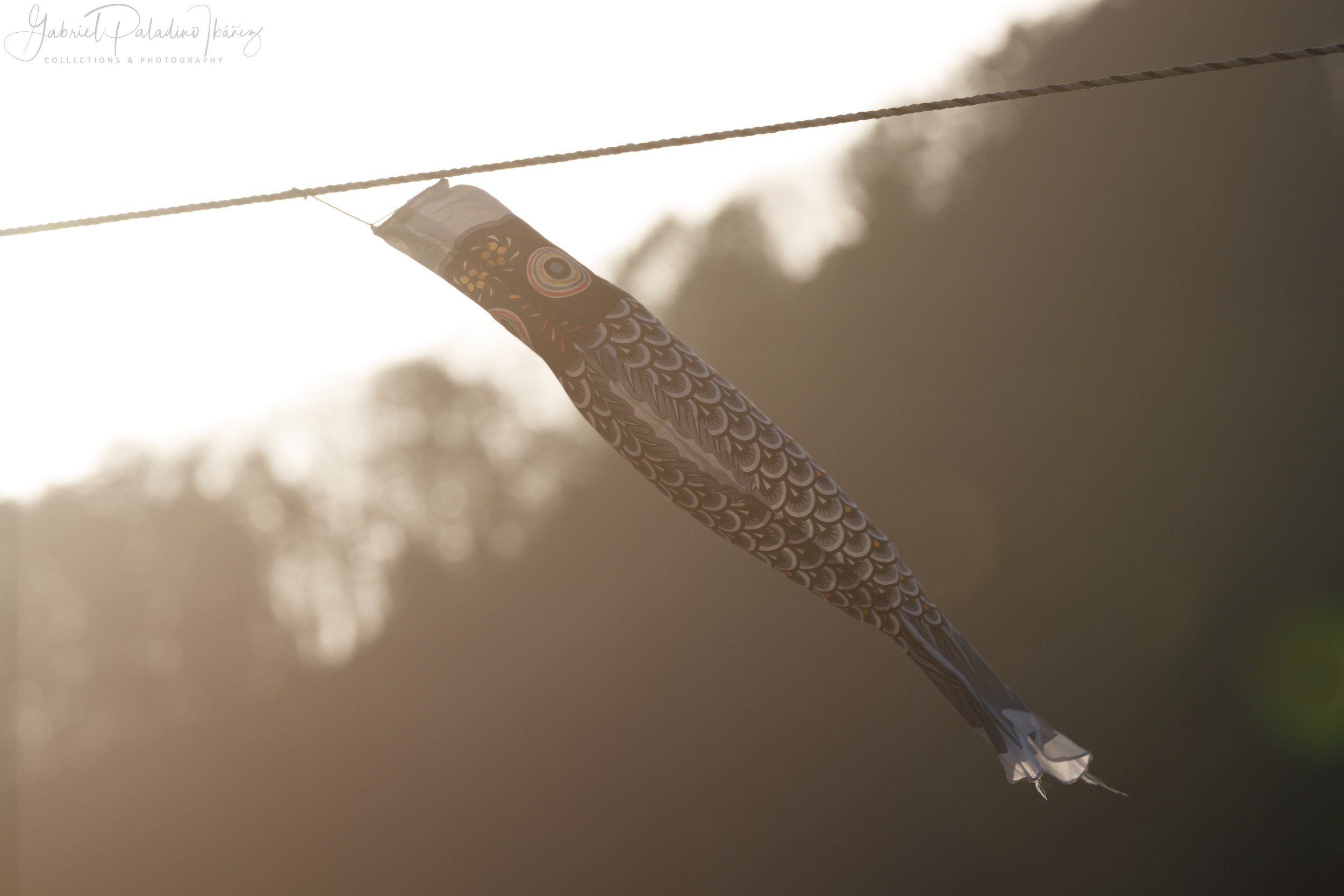
🎏 Koinobori (鯉のぼり), meaning ‘carp streamer’ in Japanese, are carp-shaped windsocks traditionally flown in Japan to celebrate Tango no sekku (端午の節句), a traditional calendrical event which is now designated as Children’s Day (子供の日, Kodomo no hi), a national holiday in Japan. Koinobori are made by drawing carp patterns on paper, cloth, or other nonwoven fabric. They are then allowed to flutter in the wind. They are also known as satsuki-nobori (皐のぼり).
Children’s Day takes place on May 5, the last day of Golden Week, the largest break for workers and also a week in which many businesses, state schools, and some private schools close for up to 9–10 days for the designated national holidays. Landscapes across Japan are decorated with koinobori from April to early May, in honor of children for a good future and in the hope that they will grow up healthy and strong.
A typical koinobori set consists of, from the top of the pole down, a pair of arrow-spoked wheels (矢車, yaguruma) with a ball-shaped spinning vane, a mounting windsock (吹流し, fukinagashi), and finally the koinobori. For the windsock above the koinobori, two main kinds are used: the five-colored windsock (五色吹流し), based on the five elements of Chinese philosophy, and patterned windsocks (柄物吹流し), often featuring a mon (家紋, family crest). The number and meaning of the carp streamers or koinobori that fly beneath the windsock has changed over time. Traditionally, the set would contain a black koinobori representing the father, followed by a smaller, red koinobori representing his eldest son. This is why, according to the Japanese American National Museum, in the traditional “children’s song,” the red one (higoi) represents the eldest son. If more boys were in the household, an additional blue, green, and then, depending on the region, either purple or orange koinobori were added. After the government’s decree that converted Boy’s Day (Tango no Sekku) into the present Children’s Day (Kodomo no Hi), the holiday came to celebrate the happiness of both boys and girls. As a result, the red koinobori came to represent the mother of the family and it is not uncommon for the color to be varied as pink. Similarly, the other colors and sizes of carp came to represent all the family’s children, both sons and daughters.
At present, the koinobori are commonly flown above the roofs of houses with children, with the biggest (black) koinobori for the father, next biggest (red or pink) for the mother, and additional smaller carps of a different color for each child in decreasing order by age.
Koinobori range from a few centimetres to a few metres long. In 1988, a 100 m (330 ft) long koinobori weighing 350 kg (770 lb) was made in Kazo, Saitama.
Kinugawa Onsen 鬼怒川温泉, Nikkō, Tochigi, Japan
Photo Taken: April 13, 2024
Did you like this post?