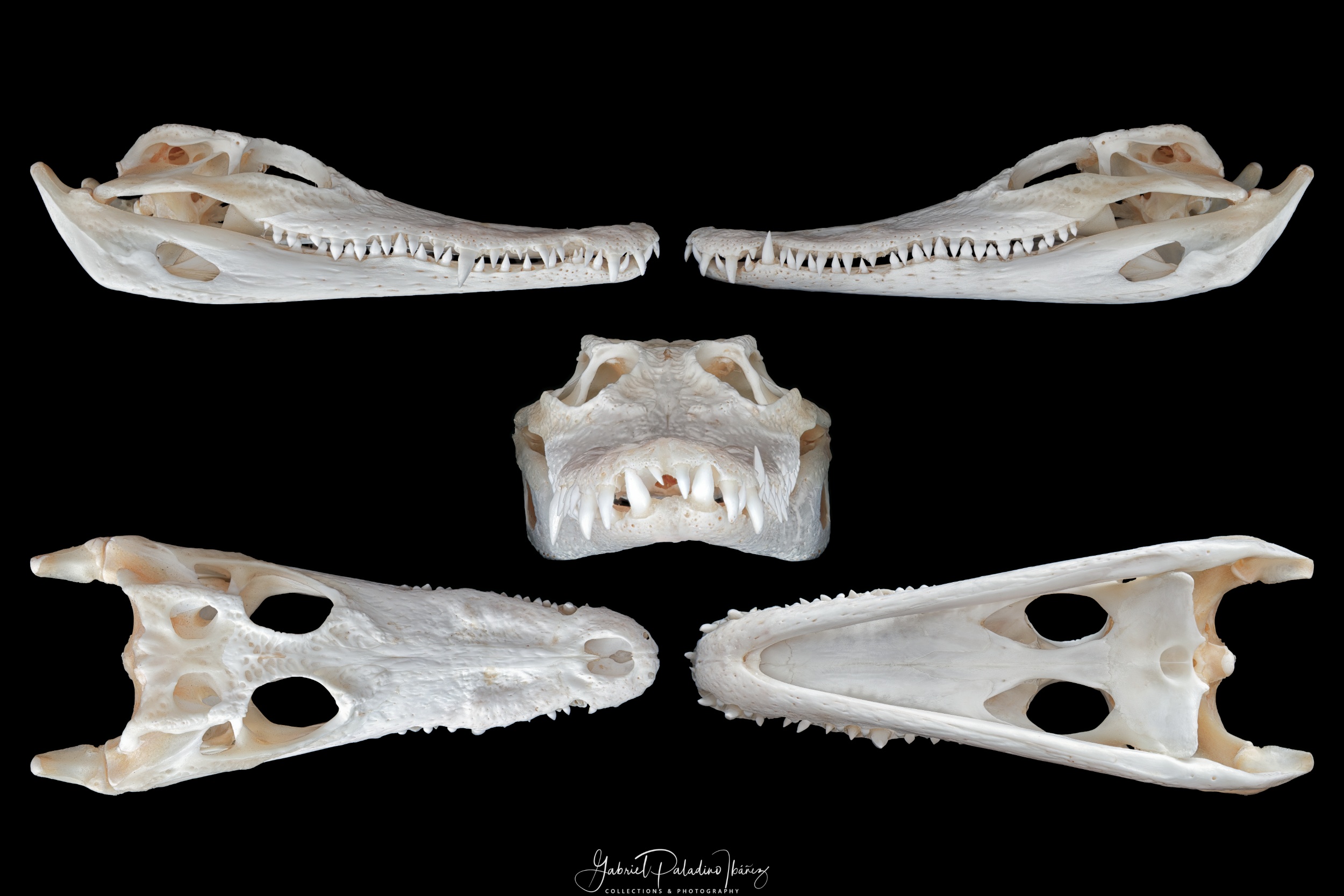
Crocodylus siamensis is native to mainland Southeast Asia, where it inhabits slow-moving freshwater rivers, swamps, marshes, and lakes. Its historical range extended across Cambodia, Laos, Thailand, Vietnam, and parts of Indonesia, including Kalimantan. Compared with other large regional crocodilians such as C. porosus, it is generally considered less aggressive toward humans.
In mature individuals, the skull develops pronounced bony crests in the posterior cranial region, including a distinctive crest associated with the squamosal region and a median ridge extending anteriorly between the orbits. These features become more pronounced with age and may be considerably less developed in juveniles and subadults. The present specimen appears consistent with a juvenile or subadult individual, with a relatively smooth cranial profile. The rostrum is relatively broad and of moderate length, consistent with the generalized cranial morphology of the species. Dentition is moderately heterodont, as in other crocodilians, with differentiated conical teeth adapted primarily for seizing and holding prey rather than specialized crushing.
• Siamese crocodile
• Cocodrilo de Siam
Scientific classification:
Kingdom: Animalia
Phylum: Chordata
Class: Reptilia
Order: Crocodylia
Family: Crocodylidae
Genus: Crocodylus
Species: C. siamensis
Today, the species is Critically Endangered in the wild, with its remaining natural populations concentrated mainly in Cambodia, together with small or localized populations elsewhere in its former range, including Indonesia. Most individuals are held in captivity, particularly in crocodile farming and breeding operations. Hybridization with C. porosus has been documented in commercial captive facilities and represents an important conservation concern, as hybrids can be difficult to distinguish morphologically and compromise the genetic integrity of captive breeding and reintroduction programs.
Photo Taken: August 02, 2026
High resolution
Flickr Gallery