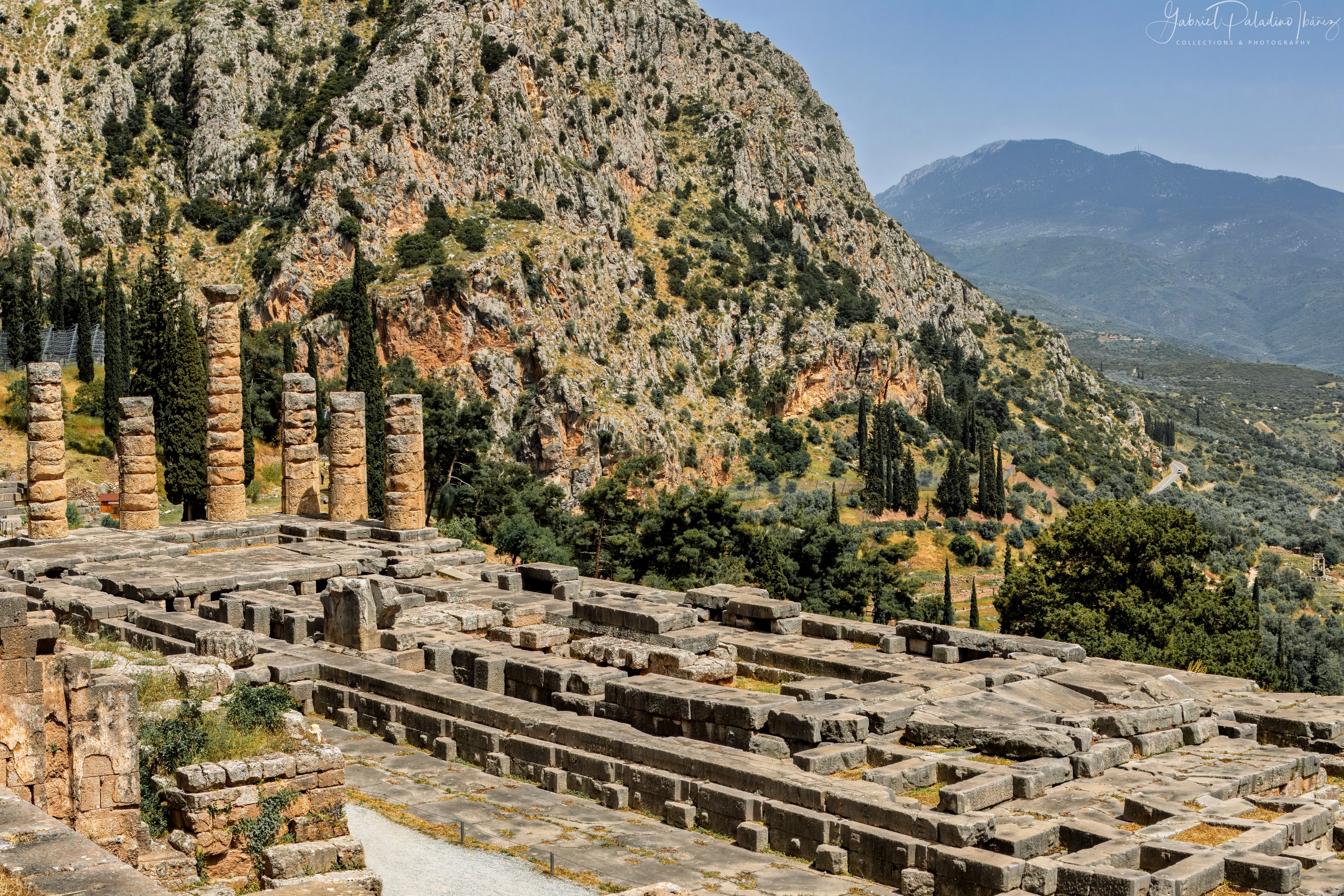
The Temple of Apollo at Delphi stands on a terrace on the southern slope of Mount Parnassus, wedged between the limestone cliffs known as the Phaedriades and overlooking the valley of the river Pleistos. The sanctuary developed in close relation to this steep landscape, which determined the arrangement of terraces, retaining walls, and monuments. Although the site was occupied from Mycenaean times, the establishment of Apollo’s cult in the first millennium BCE transformed Delphi into one of the principal religious centres of the Greek world by the sixth century BCE.
Several temples succeeded one another on the same sacred footprint. An Archaic phase culminated around 510 BCE, funded by contributions from Greek communities under the patronage of the Alcmaeonids of Athens; that building was destroyed by an earthquake in 373 BCE. The reconstruction, financed by the Amphictyonic League, was delayed by the Third Sacred War and completed around 330–327 BCE, and is attributed to the architects Spintharos of Corinth, Xenodorus, and Agathon. The rebuilt temple preserved the Doric peripteral scheme with six columns on the façades and fifteen along the flanks. Fourth‑century BCE inscriptions record costs, labour, and materials, offering a rare glimpse into ancient construction logistics.
Delphi functioned as a Panhellenic sanctuary rather than the religious centre of a single city. Communities from across the Greek world erected treasuries, monuments, and dedications along the Sacred Way, where religious devotion and political rivalry became materially intertwined. The sanctuary also hosted the Pythian Games, held every four years in honour of Apollo.
The oracle lay at the heart of Delphi’s authority. The Pythia, Apollo’s priestess, delivered responses sought by individuals and city‑states on matters ranging from colonization to war and policy. Inside the temple were the pronaos, the naos, and the restricted adyton—the inner area associated with the oracle—and the omphalos, the stone regarded in Greek tradition as the “navel” of the world.
The sanctuary retained its importance into the Roman period, but the suppression of pagan cults in late antiquity, ordered by Emperor Theodosius I, led to its closure. Earthquakes, landslides, and the reuse of ancient building materials altered the site until systematic excavations by the French School at Athens began in 1892, revealing the foundations and columns visible today. What endures at Delphi is not merely an isolated temple but a complex archaeological landscape whose religious, political, and cultural significance was forged over centuries; in this case, architecture and terrain are inseparable.
Camera: Canon EOS R7
Lens: TAMRON SP 28-75mm F/2.8 Di A09E
Capture Information:
Focal Length: 28.0 mm
Shutter Speed: 1/500
Aperture: f/8.0
ISO: 100
Photo Taken: May 09, 2026
High resolution
Flickr Gallery