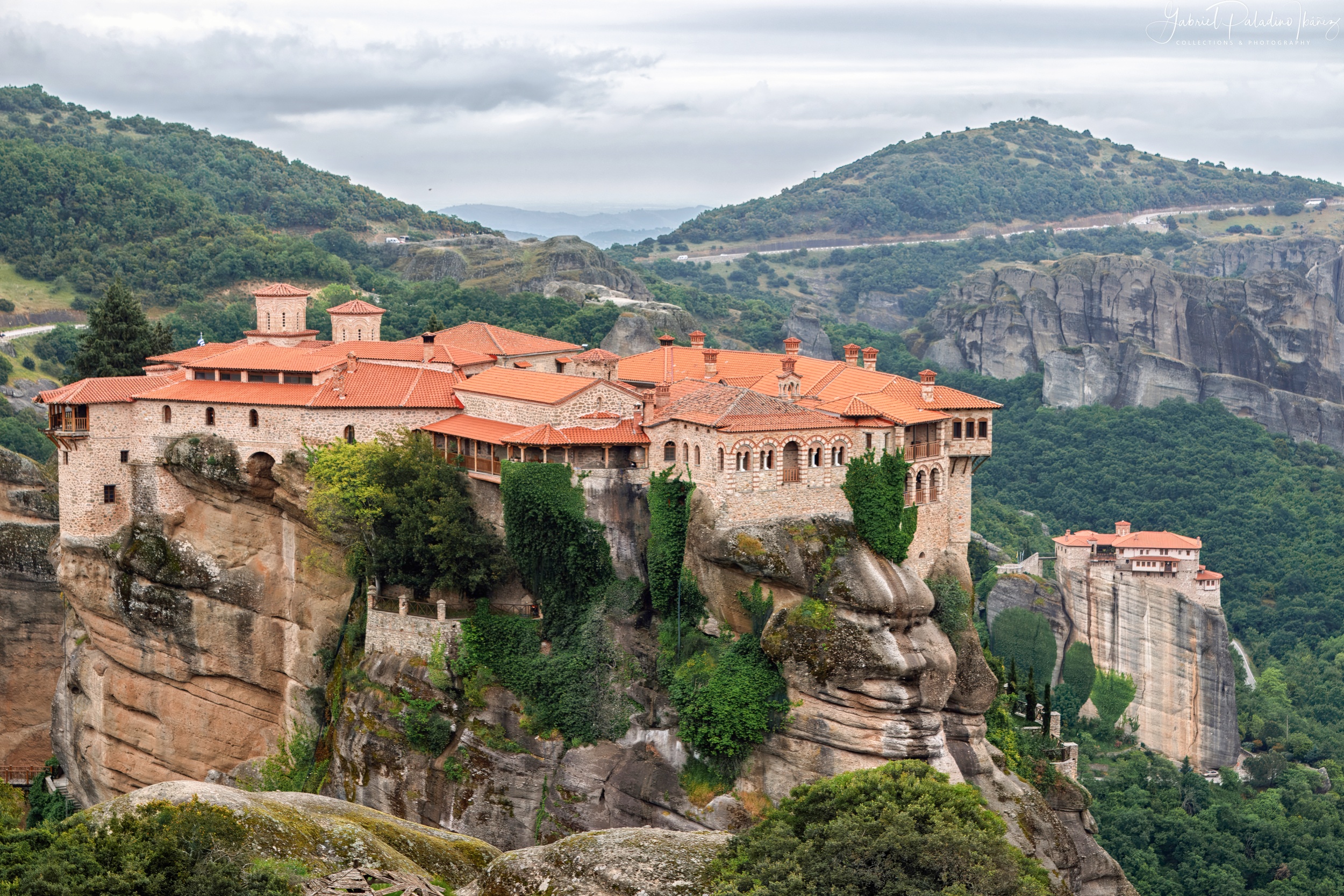
Varlaam (foreground) · Roussanou (background)
Two of the six Eastern Orthodox monasteries that remain active within the Meteora complex — a UNESCO World Heritage Site since 1988 — Varlaam and Roussanou embody, across a single field of view, the full range of monastic ambition that defines this landscape of central Greece.
Varlaam, the second largest monastery of Meteora, commands a broad rock plateau directly opposite the Great Meteoron, its sprawling mass filling the foreground of the image. The site’s history begins in 1350, when the ascetic Varlaam climbed the rock and built three small chapels, a cell, and a water tank; after his death, the summit was abandoned for roughly two centuries. The monastery was re-founded in 1517 by the hieromonks Theophanes and Nektarios Apsarades from Ioannina, who spent twenty-two years hauling all construction materials to the top using a tower, a rope and pulley system, and a basket — then raised the Katholikon itself in twenty days. The Katholikon, dedicated to All Saints and completed between 1541 and 1542 in the Athonite cross-in-square style, was decorated in 1548 by the master painter Frangos Katelanos of Thebes; the esonarthex received its own fresco cycle in 1566. The tower still houses the original windlass and rope basket from 1536. When asked how often the rope was replaced, a nineteenth-century abbot famously replied: "Only when it breaks." The former refectory now serves as a museum housing over 300 manuscripts, portable icons, carved wooden crosses, and embroidered liturgical objects accumulated across centuries of monastic life. Today, a permanent flight of stone steps carved into the cliff face has replaced those ropes as the primary means of ascent.
Roussanou, visible in the background, was founded around 1545 by the brothers Maximos and Ioasaph of Ioannina on the site of an earlier church. Its name remains etymologically uncertain — the monastery is formally dedicated to Saint Barbara — though it most likely derives from the name of an earlier hermit who occupied the rock. Because its sandstone pillar is exceptionally narrow, the entire structure was engineered vertically across three levels: the Katholikon and monastic cells on the ground floor, with reception halls, additional quarters, and an exhibition room above. The Katholikon, dedicated to the Transfiguration of Christ, was decorated with frescoes in 1560 under the direction of the hieromonk Arsenios; the cycle shows close stylistic ties to the Cretan School and appears to have drawn from the palette established by Katelanos at nearby Varlaam. The monastery declined rapidly after its founding and by 1614 had become subordinate to Varlaam; it fell into further disrepair in the centuries that followed, suffered looting during the German occupation of World War II, and was subsequently restored by the regional archaeological service. Since 1988 it has functioned as a convent, home to a small community of nuns.
Together, Varlaam and Roussanou represent the two poles of Meteora’s monastic tradition: the one expansive, horizontally developed, and institutionally unbroken across five centuries; the other compressed, vertical, and reborn — a place where the boundary between human construction and raw rock face has all but dissolved.
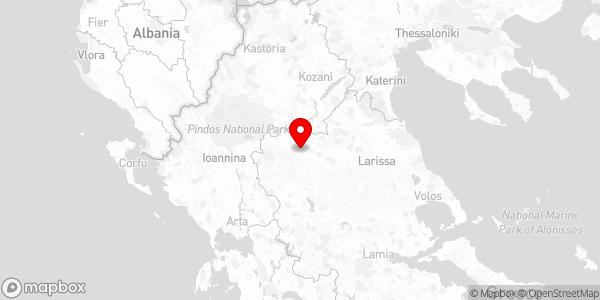
Meteora, Thessaly, Greece
Camera: Canon EOS 77D / 9000D
Lens: TAMRON SP 28-75mm F/2.8 Di A09E
Capture Information:
Focal Length: 47.0 mm
Shutter Speed: 1/80
Aperture: f/5.0
ISO: 125
Photo Taken: May 08, 2026
High resolution
Flickr Gallery