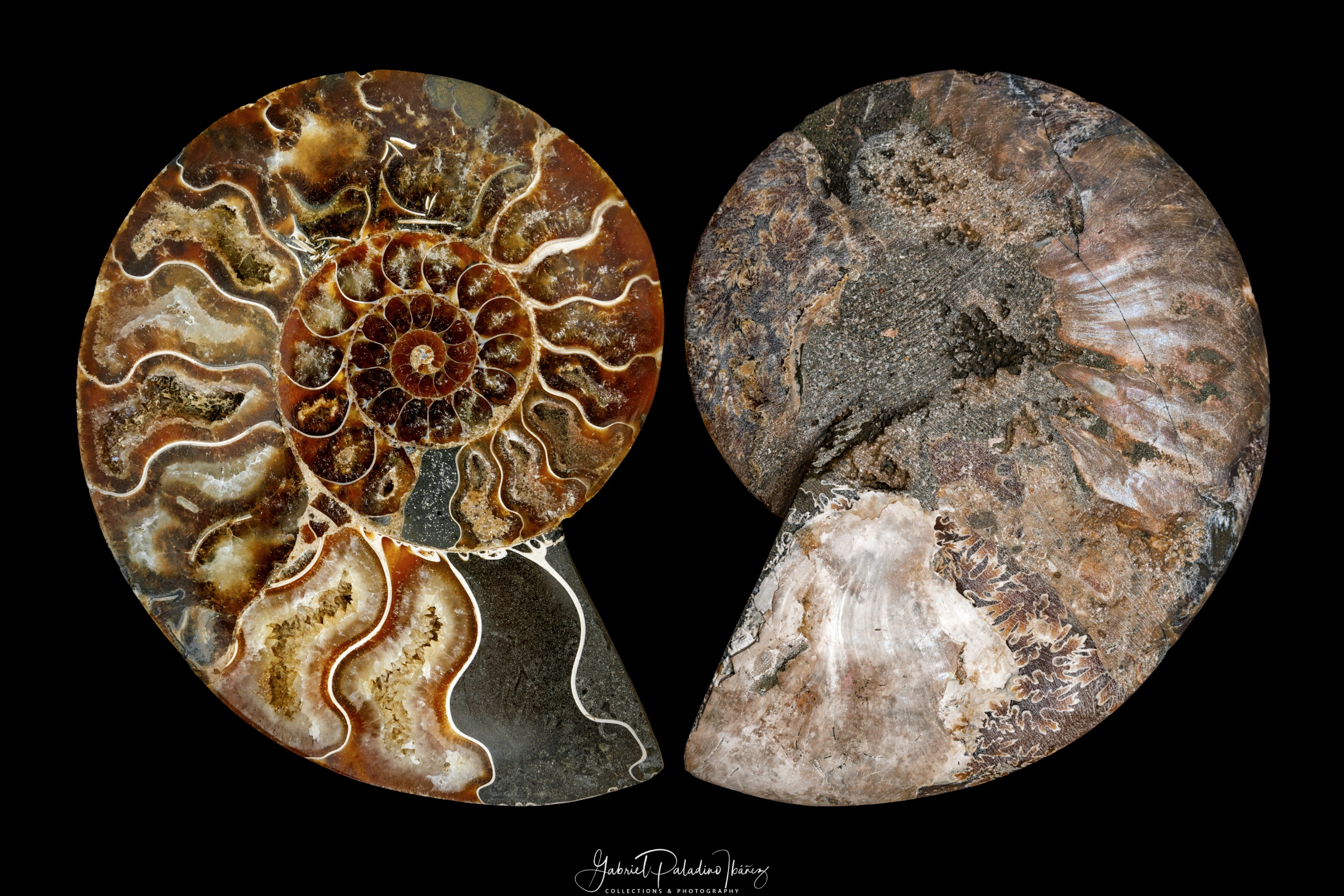
Cleoniceras is a genus of ammonites from the Lower Cretaceous, flourishing during the Albian Stage, approximately 113 to 100 million years ago. Although known from several regions of the former Tethyan realm, Madagascar — particularly the marine limestones and marls of the Mahajanga Basin, in the island’s northwest — has yielded abundant and well-preserved material, making it a key Albian locality for this group. These cephalopods are recognized by their characteristic shells: rather involute, high-whorled, with a small umbilicus and a venter ranging from arched to acute.
When a specimen is cut and polished, it exposes a striking internal architecture. The phragmocone — the chambered portion of the shell used in buoyancy regulation during the animal’s life — is divided into a series of camerae separated by septa, growing progressively from a minute protoconch, barely the size of a grain of rice, to several centimeters across in the outer whorls. Following burial, some chambers became infilled with fine sediment, while others were left as hollow voids later lined with secondary minerals, most commonly calcite and, in some cases, quartz, producing the marked contrasts of color and texture typical of these polished sections; the degree of mineralization depends primarily on local burial and diagenetic conditions rather than on the size of the shell itself. The junction between each septum and the shell wall forms the suture line: a complex, winding, branch-like pattern that runs along every whorl and is one of the diagnostic features used to distinguish ammonite taxa. Externally, when left unpolished, the shell typically preserves its original ribbing — fine falcoid to sigmoidal ribs arising in pairs from umbilical tubercles and fading on the outermost whorls. While most fossilized shells from the Mahajanga Basin show their original aragonite replaced by stable calcite, a notable number of specimens retain patches of the original iridescent nacreous (mother-of-pearl) layer, a preservation style for which Madagascar’s Cleoniceras is well known among collectors and paleontologists alike.
Scientific Classification:
Kingdom: Animalia
Phylum: Mollusca
Class: Cephalopoda
Subclass: Ammonoidea
Order: Ammonitida
Superfamily: Hoplitoidea (formerly Hoplitaceae)
Family: Hoplitidae
Subfamily: Cleoniceratinae
Genus: Cleoniceras
Species: Cleoniceras sp.
Era: Mesozoic
Period: Cretaceous (Albian, ~113–100 Ma)
Origin: Type locality, Mahajanga Basin, Madagascar (exact locality not determined for this specimen)
Dimensions: 130 x 100 mm
Geological Significance:
Species of Cleoniceras are important biostratigraphic markers for the Albian Stage: their relatively rapid evolutionary turnover and restricted stratigraphic ranges allow geologists to correlate marine sedimentary sequences across the ancient Tethys Ocean. Because successive growth stages — from protoconch to final body chamber — are preserved within a single shell, the genus has also been a useful subject for studies of ammonoid ontogeny and morphological adaptation. The genus’s diversity in Madagascar, including the subgenus Paracleoniceras — under which species such as besairiei (now widely reassigned to the genus Aioloceras) and tenuicostulatum were originally described — has been extensively documented by the French paleontologist Maurice Collignon in his Atlas des Fossiles Caractéristiques de Madagascar, which remains a primary reference for identifying Albian ammonites from the region. Precise species-level identification of any given specimen, however, requires expert analysis of venter shape and suture detail together with knowledge of the exact locality and stratigraphic horizon it came from.
Photo Taken: June 04, 2026
High resolution
Flickr Gallery