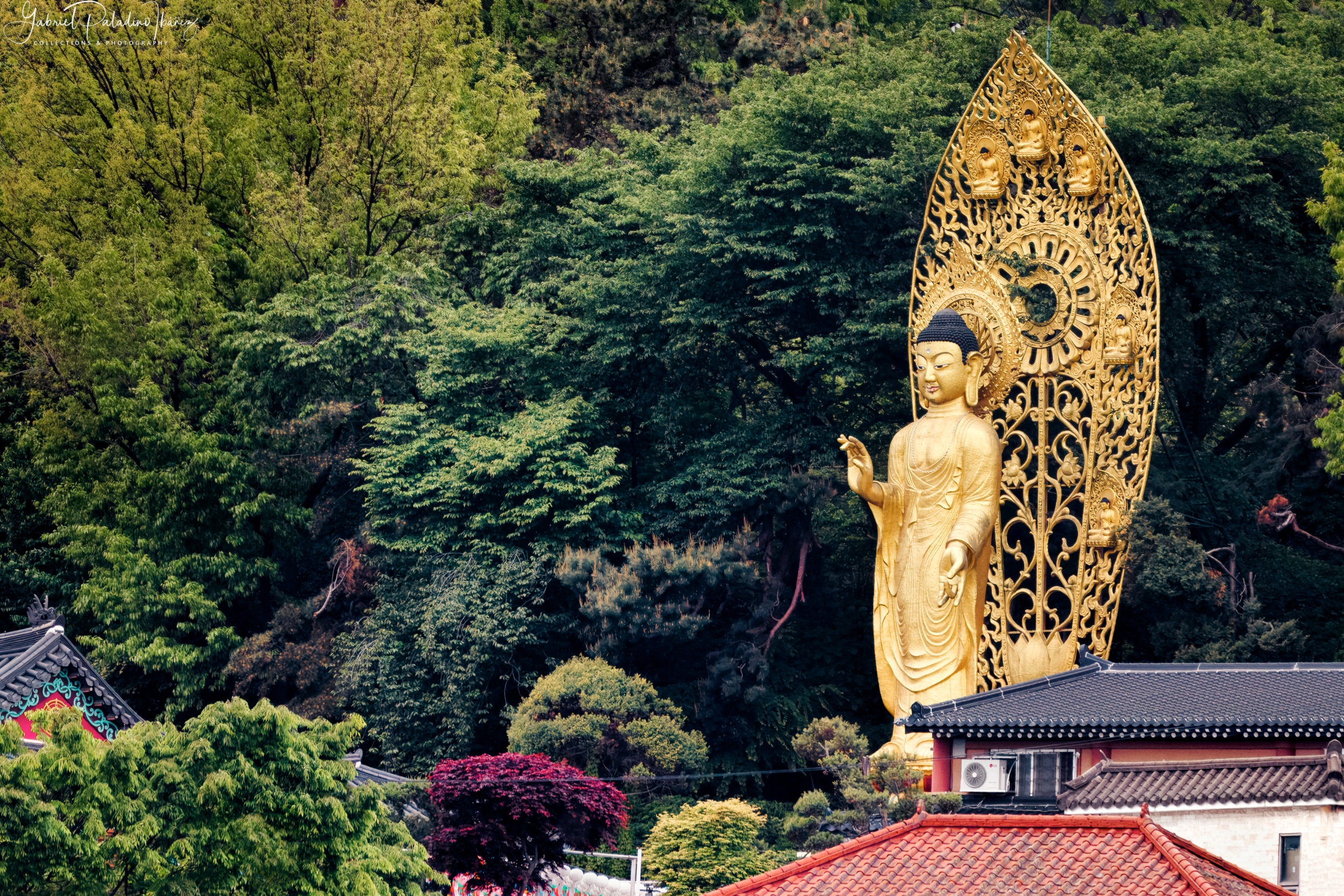
The giant golden Buddha of Daeseungwon Temple (대승원) rises on the slopes of Paldalsan Mountain in the historic city of Suwon, South Korea. The temple was founded in 1954 under the name Mahasa (마하사) and is associated with the Mahayana Buddhist tradition.
The temple complex is located near the wooded hills that surround Hwaseong Fortress (수원 화성), the late-18th-century fortified wall built during the reign of King Jeongjo. From several sections of the fortress and nearby urban areas, the statue is visible rising above the surrounding trees.
At the center of the temple stands a 19-meter-tall golden Buddha statue, which has become one of the most recognizable visual landmarks in this part of Suwon. The figure is depicted standing, a common representation in East Asian Mahayana Buddhist sculpture. One hand is raised with the palm facing outward, a gesture traditionally associated with reassurance and protection, while the other hand extends downward in a welcoming or compassionate pose.
Behind the statue is a large ornamental mandorla, an openwork halo structure that frames the figure. The mandorla contains decorative flame-like patterns and several small seated Buddha figures placed within niches. Such halos symbolize the radiance of enlightenment surrounding the Buddha, while the smaller figures represent other awakened beings within the Buddhist cosmological tradition.
Situated on the wooded hillside of Paldalsan, the statue’s golden surface contrasts strongly with the surrounding forest, making it visible from many points in the city below and from the historic walls of Hwaseong.
Suwon, Gyeonggi-do, South Korea

Camera: Canon EOS 77D / 9000D
Lens: Sigma 150-600mm F5-6.3 DG OS HSM | Contemporary
Capture Information:
Focal Length: 232.0 mm
Shutter Speed: 1/320
Aperture: f/5.6
ISO: 640
Photo Taken: May 05, 2025
High resolution
Flickr Gallery