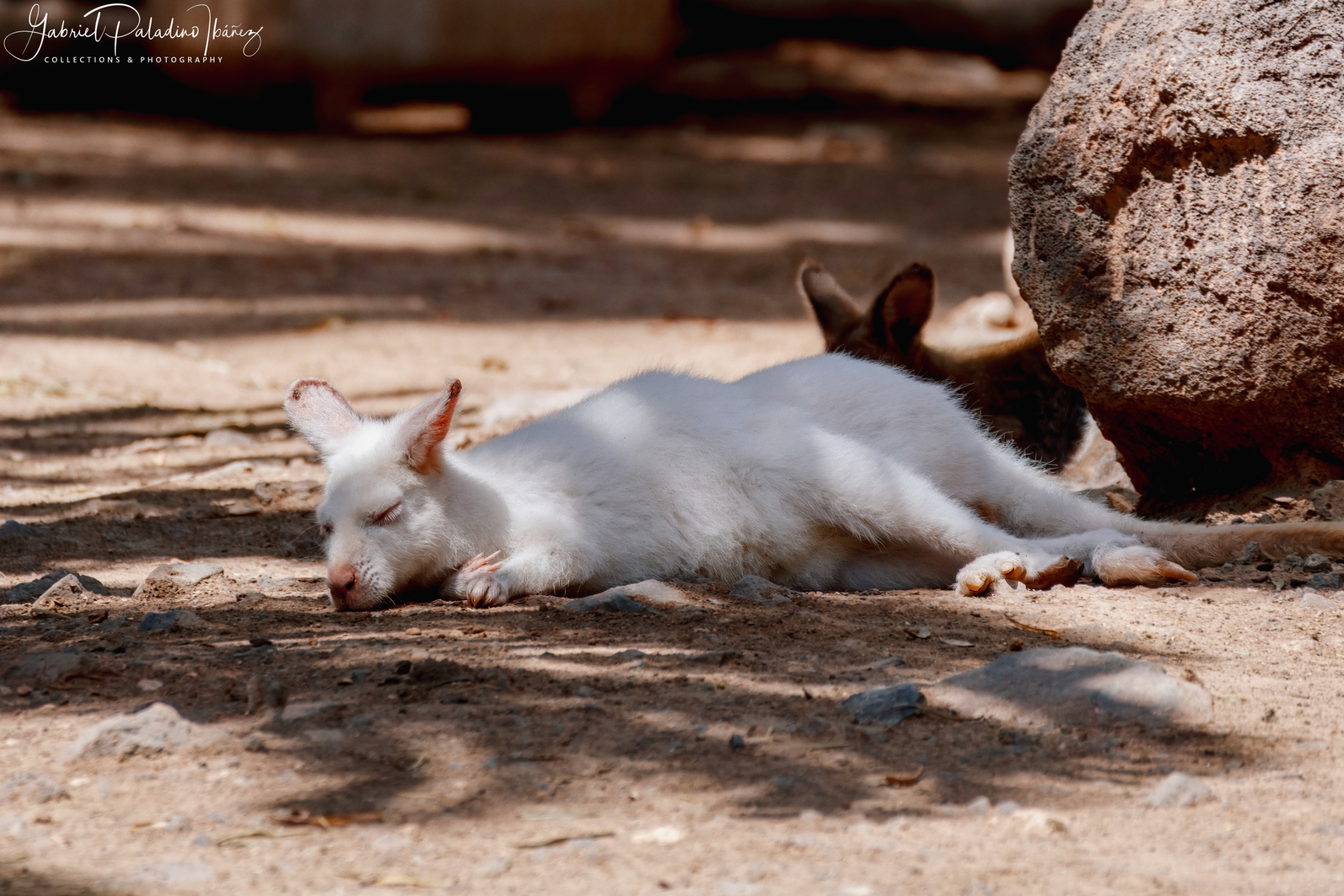
Bennett’s wallabies (Macropus rufogriseus) are medium-sized marsupials with dense, soft fur, typically grayish-brown on the back and lighter on the belly, with reddish tones on the shoulders and neck. They have strong hind legs adapted for hopping, a long, muscular tail for balance, and a compact head with large, alert ears.
The albino variety, like the specimen at Oasis Wildlife, presents white fur, pink skin, and pale or reddish eyes due to the absence of melanin. While this coloration is rare in the wild—where it can increase vulnerability to predators—it can occur naturally through genetic variation.
Bennett’s wallabies are native to eastern Australia and Tasmania, where they inhabit eucalyptus forests, coastal scrub, and grasslands. They are mostly nocturnal grazers, feeding on grasses and leaves, and are known for their solitary or small-group habits, except during mating season. Females give birth to a single joey, which continues developing inside the pouch for several months.
Although their populations are considered stable and the species is classified as Least Concern by the International Union for Conservation of Nature (IUCN), habitat loss and road accidents are ongoing threats in their native range.
• Bennett’s wallaby
• Wallaby de Bennett, wallaby rojo-grisáceo, wallaby de cuello rojo
Scientific classification:
Domain: Eukaryota
Kingdom: Animalia
Phylum: Chordata
Class: Mammalia
Order: Diprotodontia
Family: Macropodidae
Genus: Macropus
Species: M. rufogriseus
Oasis Wildlife Fuerteventura, La Lajita, Fuerteventura, Islas Canarias
Camera: Canon EOS 750D / Rebel T6i
Lens: Sigma 150-600mm F5-6.3 DG OS HSM | Contemporary
Photo Taken: April 16, 2023
High resolution
Flickr Gallery
Did you like this post?