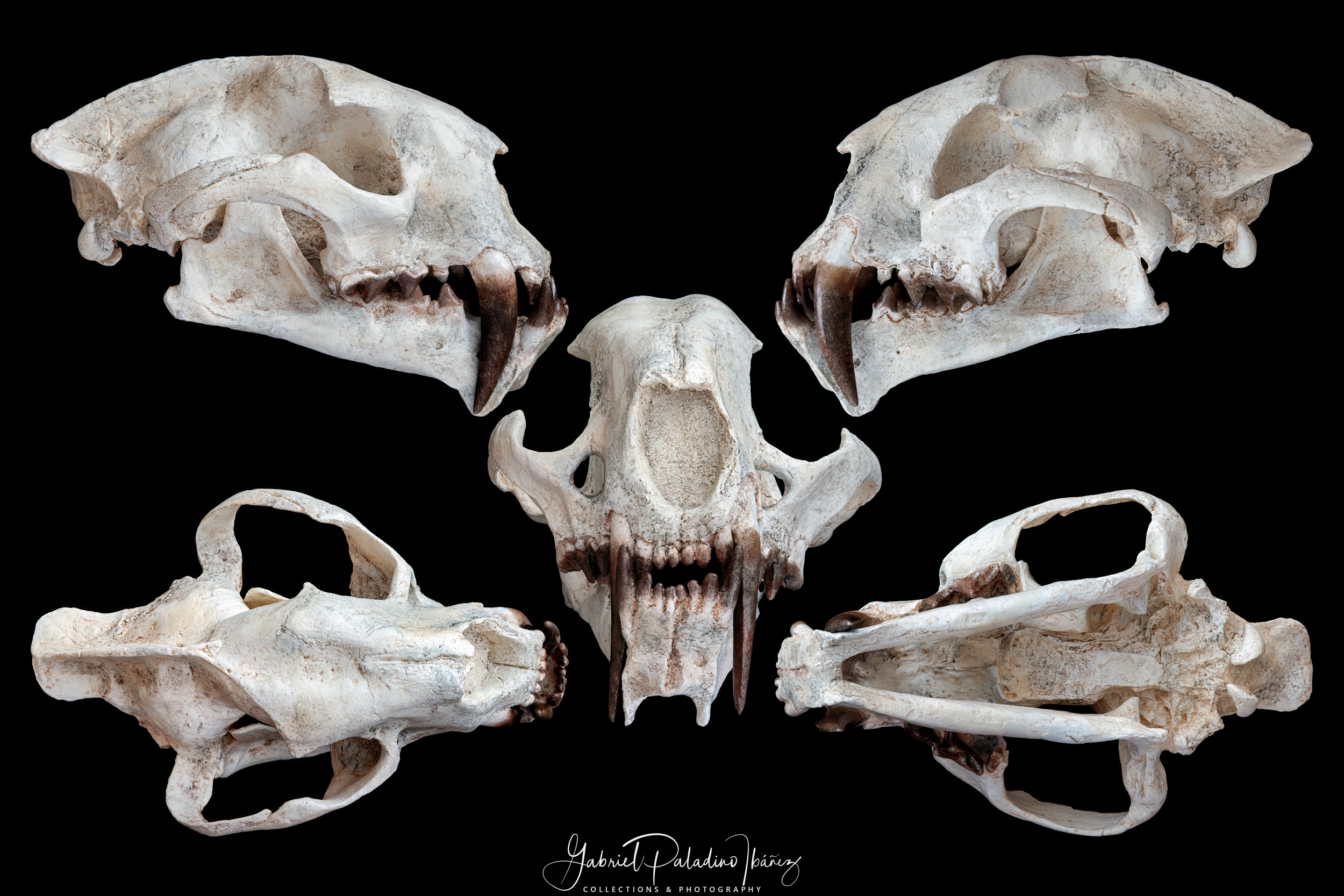
Dinictis felina was an extinct carnivore that roamed the North American plains during the Late Eocene to Early Oligocene, approximately 40 to 35 million years ago. It belonged to the genus Dinictis, one of the earliest and most basal members of the Nimravidae family—commonly referred to as “false saber-toothed cats.” Although it resembled modern felines in some aspects, Dinictis was part of a separate evolutionary lineage within Carnivora and lacked many of the advanced adaptations seen in later saber-toothed predators.
Cougar-sized and built for stealth, it had a flat-footed (plantigrade) stance, relatively short and powerful limbs, and a long tail for balance. Its saber-like canines were elongated but modest compared to those of later nimravids or true machairodontine cats, indicating an early stage in the evolution of saber-toothed predation.
Scientific classification:
Domain: Eukaryota
Kingdom: Animalia
Phylum: Chordata
Class: Mammalia
Order: Carnivora
Suborder: Feliformia
Family: †Nimravidae
Subfamily: †Nimravinae
Genus: †Dinictis
Species: †Dinictis felina (Leidy, 1854)
Taxonomic notes:
Although various species were once attributed to the genus Dinictis, a 2016 taxonomic revision determined that the genus is monotypic, containing only the species †Dinictis felina. It was originally named by Joseph Leidy and later placed in Nimravidae by Cope (1880), and in the subfamily Nimravinae by Flynn and Galiano (1982), Bryant (1991), and Martin (1998).
The skull of Dinictis felina displays transitional features: slightly elongated upper canines, a moderately shortened snout, and pronounced zygomatic arches—suggesting strong jaw musculature. Unlike true cats (which are digitigrade), Dinictis was plantigrade, walking on the soles of its feet, a trait it shared with early carnivores. This posture, along with its muscular build, implies a lifestyle based more on stalking and ambush than on long pursuits.
This cast comes from a rare fossil specimen unearthed in South Dakota’s Brule Formation, a rich Oligocene-aged deposit. The replica faithfully captures the defining traits of Dinictis: its moderately sabered canines, deep-set eye orbits, and powerful jawline—offering a window into the early evolutionary stages of saber-toothed predation in North America.
Photo Taken: May 25, 2025
Did you like this post?