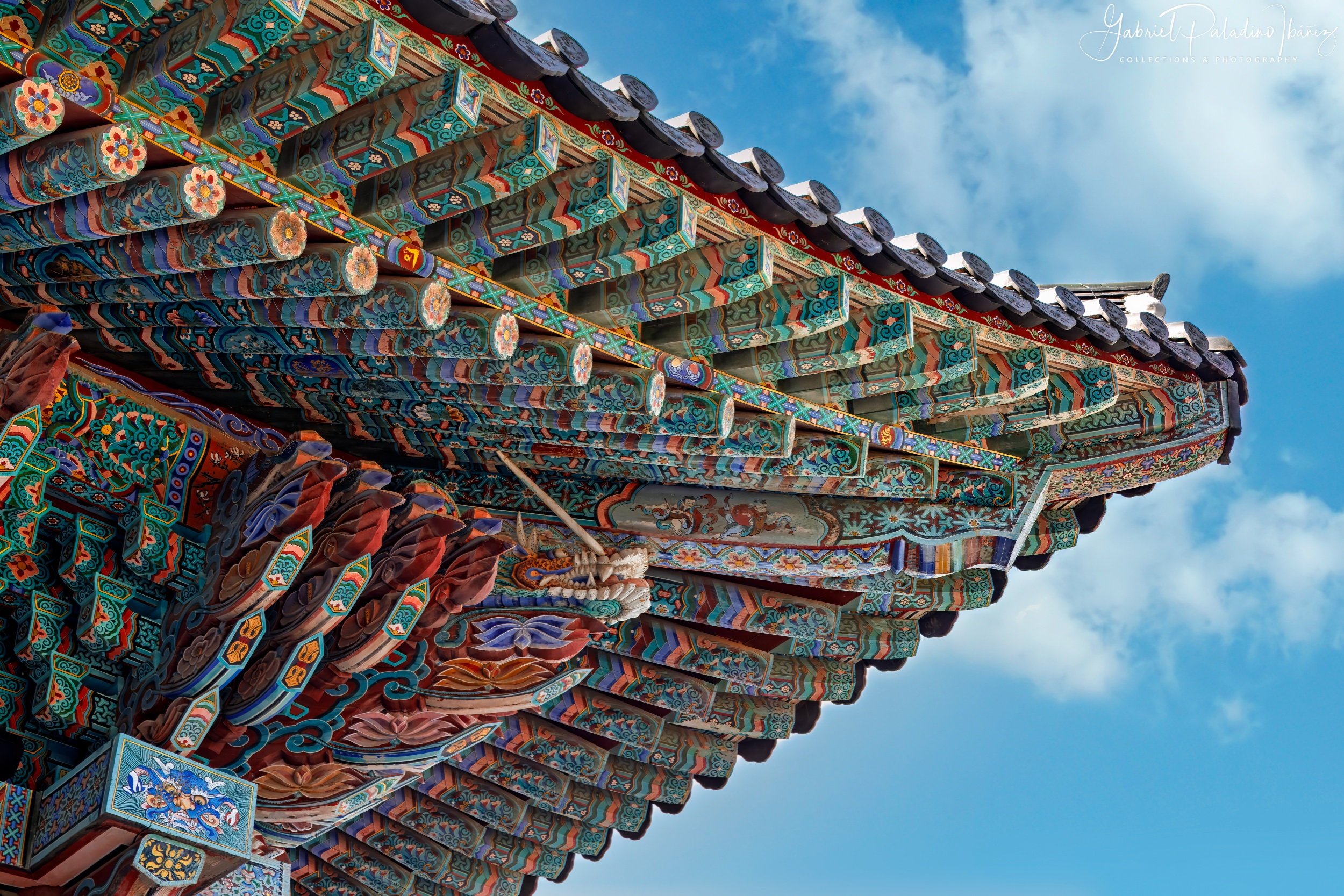
The vibrant dancheong of the main temple, showcasing intricate paintings, vivid colors, and a striking dragon head detail.
Haedong Yonggungsa (해동용궁사, Hanja 海東龍宮寺) stands strikingly on the seaside cliffs of Gijang-gun (기장군), Busan (부산), making it one of the rare Korean Buddhist temples built along the coast. According to legend, the monk Naong Hyegeun (나옹 혜근, 1320–1376) dreamed that the Sea God of the East would bring rain if a temple were constructed atop Mount Bongnae (봉래산). In response, Bomun Temple (보문사) was established in 1376 but was later destroyed during the Imjin War of 1592. The site was revived in the 1930s by the monk Ungang (운강), who renamed it Haedong Yonggungsa. The temple complex, anchored by its Daeungjeon Main Hall (대웅전) completed in 2005, now venerates Haesu Gwaneum Daebul (해수관음대불), the Sea-Water Bodhisattva of Compassion.
A hallmark of Haedong Yonggungsa is its dancheong (단청)—the traditional Korean decorative painting applied to wooden structures using five symbolic colors (blue, red, white, black, and yellow), intended both to embellish and to shield from the elements and insects. Throughout the Daeungjeon, visitors can find numerous dragon-head carvings (용두, yongdu) adorning beam ends and roof eaves, their manes and scales highlighted with layers of mineral pigments and gilded accents.
Haedong Yonggungsa, Gijang-gun, Busan, South Korea
Photo Taken: April 28, 2025
High resolution
Flickr Gallery
Did you like this post?