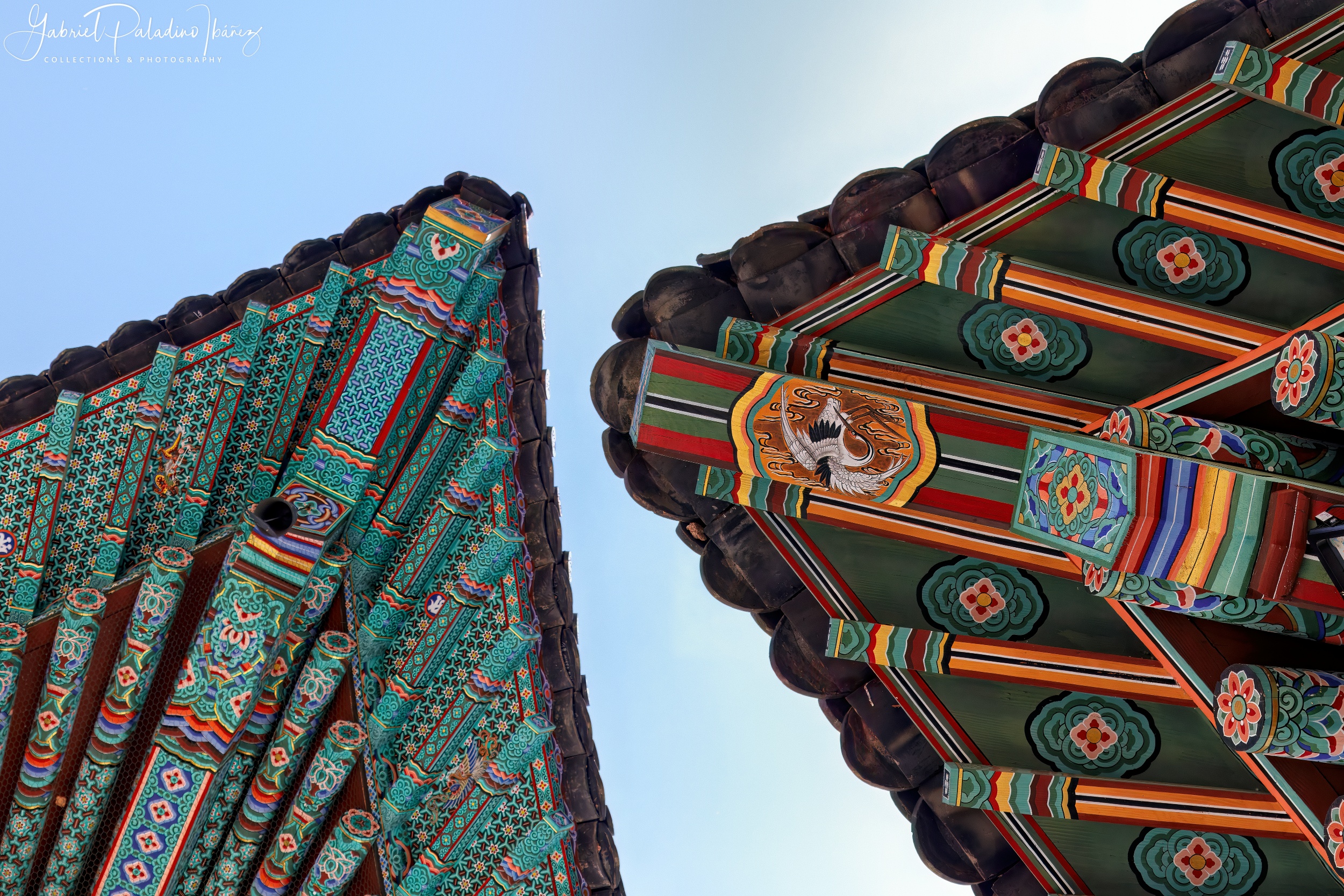
This photo marks the beginning of a series captured during my trip to South Korea this year—a journey filled with color, tradition, and discoveries. One of the most striking elements I encountered was Dancheong, the traditional Korean decorative painting that transforms temples and palaces into vibrant works of art. In the heart of Seoul’s Jongno district stands Jogyesa Temple, one of the main centers of Korean Buddhism. Here, Dancheong can be seen in its full splendor, especially on the Daeungjeon (Main Hall), where vivid reds and emerald greens contrast beautifully with the natural wood tones. Every beam, eave, and column is adorned with hand-painted motifs such as lotus flowers, stylized clouds, and mythical creatures. Dancheong is far more than decoration. It follows a strict system of patterns and symbolic colors based on the traditional Korean five-element theory (Obangsaek – 오방색): blue (wood), red (fire), yellow (earth), white (metal), and black (water). These colors are used not only for aesthetic harmony and spiritual balance, but also to protect the wooden structures from weather and insects. Complementing this visual language are the Cheoma (처마), the multi-layered, upturned eaves characteristic of traditional Korean architecture. These structures are not only functional—distributing the roof’s weight and withstanding strong winds—but also enhance the Dancheong by casting shadows that make the colors come alive under sunlight. Although the current temple building was reconstructed in 1938, the Dancheong is still applied using traditional methods passed down by generations of skilled artisans. This practice is officially recognized as an Intangible Cultural Heritage of South Korea. In 2023, a commemorative stamp was even issued in honor of this artistic tradition.
Photo Taken: May 04, 2025
High resolution
Flickr Gallery
Did you like this post?