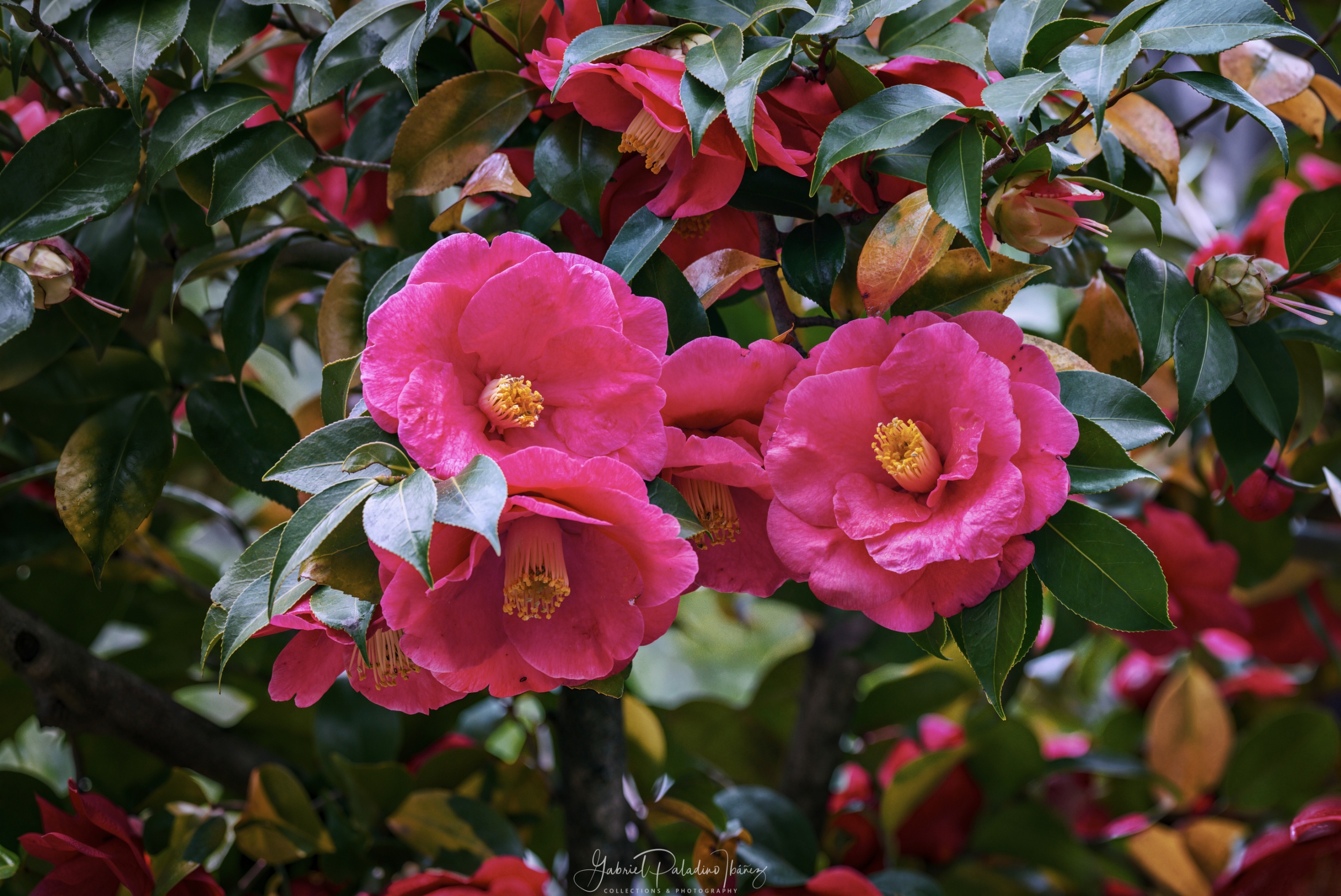
Camellia japonica, known in Japan as Tsubaki, is a long-lived evergreen shrub or small tree in the family Theaceae, native to East Asia (China, Korea, and Japan). Cultivated for over a millennium, it holds deep cultural significance in temple and palace gardens — including historic sites such as Kotoku-in in Kamakura — with some specimens documented to live more than 500 years.
Its leathery, glossy dark-green leaves are alternate, ovate to elliptic, with finely serrated margins, typically 5–11 cm long. Flowering runs from winter through spring, with blooms ranging from single, five-petaled forms to semi-double, double, and peony-type flowers, often centered on a dense column of golden-yellow stamens.
Wild flowers measure roughly 6–10 cm, but many cultivated Japanese forms are considerably larger: the heirloom cultivar ‘Akashigata’ (known in the West as ‘Lady Clare’), imported to Europe before 1859, produces semi-double blooms of 10–14 cm — a size range compatible with, though not proof of, the specific cultivar in a given photograph. Over 2,000 cultivars (by some counts up to 30,000) exist worldwide.
By contrast, Camellia sasanqua blooms in autumn with smaller flowers (5–7.5 cm), while Camellia sinensis is grown for tea.
• Tsubaki (椿, つばき, ツバキ)
• Common Camellia, Japanese Camellia
• Camelia, Camelia japonesa
Scientific classification:
Kingdom: Plantae
Clade: Tracheophytes
Clade: Angiosperms
Clade: Eudicots
Order: Ericales
Family: Theaceae
Genus: Camellia
Species: Camellia japonica
— Cultivar: Akashigata (アカシガタ), sin. ‘Lady Clare’
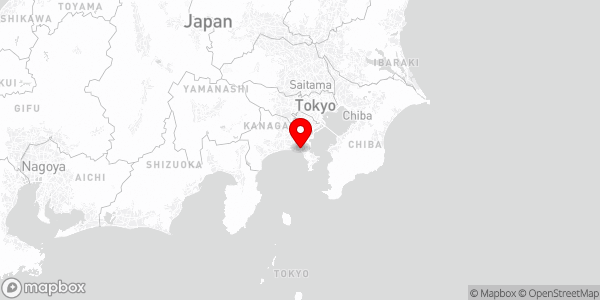
Kōtoku-in (高徳院), Kamakura, Kanagawa, Japan
Camera: Canon EOS 77D / 9000D
Lens: Sigma 150-600mm F5-6.3 DG OS HSM | Contemporary
Capture Information:
Focal Length: 244.0 mm
Shutter Speed: 1/400
Aperture: f/5.6
ISO: 800
Photo Taken: April 08, 2024
High resolution
Flickr Gallery