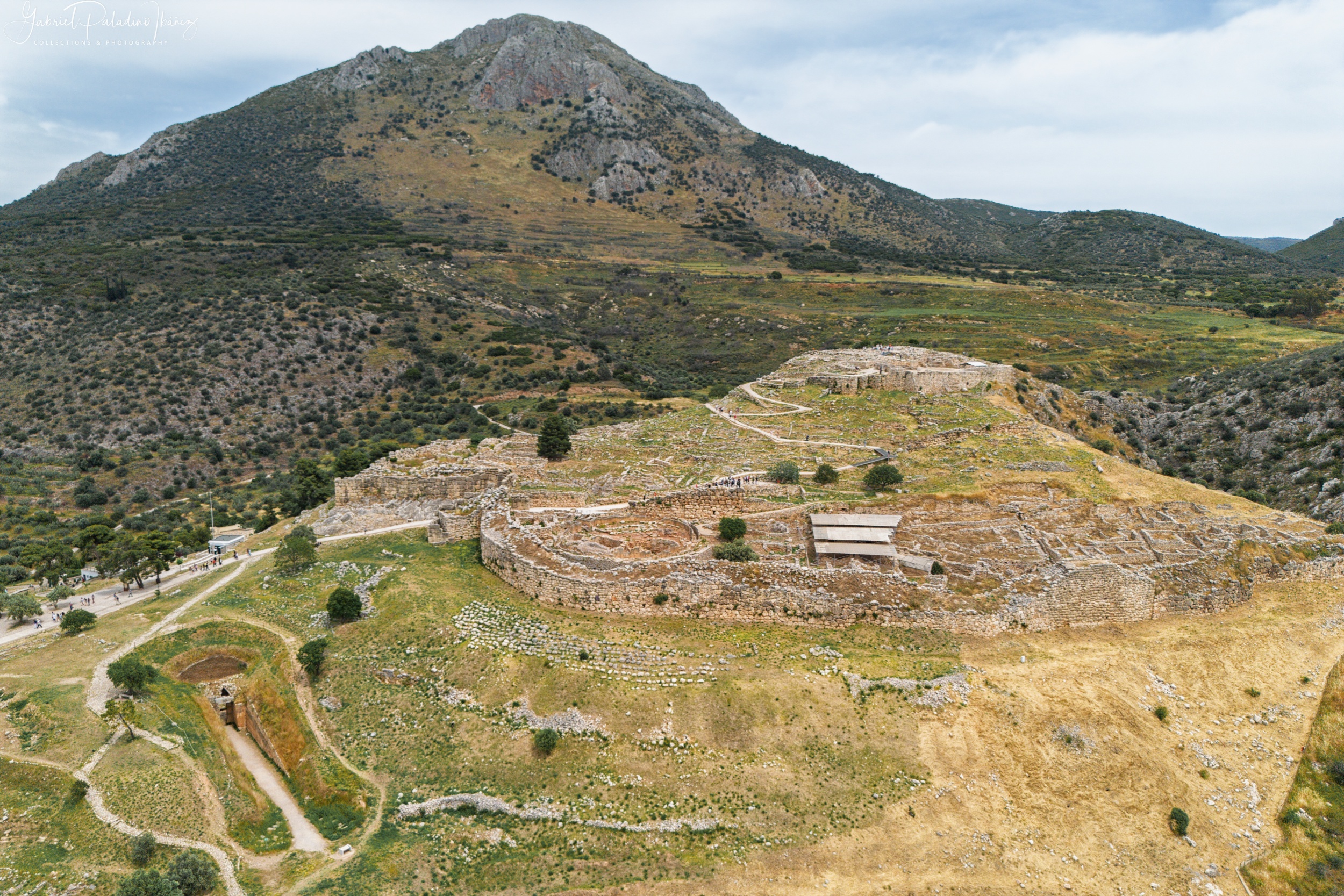
Situated on a naturally defensible hill in the Argolid region of the northeastern Peloponnese, Mycenae served for centuries as the political, administrative, and ceremonial center of Mycenaean civilization, the dominant culture of Bronze Age mainland Greece. Occupied since the Neolithic period, the site reached its fullest development between approximately 1600 and 1100 BC, with its most intensive constructive phase concentrated between 1350 and 1200 BC. It was later memorialized in the Homeric epics as the kingdom of Agamemnon, though the historical city predates those poems by several centuries.
The citadel is defined by its Cyclopean fortifications, constructed from limestone blocks of such scale that classical-era Greeks attributed them to the mythical Cyclopes. Expanded across at least three major phases during the 13th century BC, the walls eventually enclosed Grave Circle A, a 16th-century BC cemetery containing six shaft graves in which nineteen individuals were interred with objects of exceptional craftsmanship, including gold vessels, inlaid weapons, and elaborate jewelry. Among them was the gold funerary mask known as the "Mask of Agamemnon", which modern chronology places roughly three centuries before the ruler whose name it carries. Heinrich Schliemann’s excavations of 1876 brought these discoveries to international attention and established Bronze Age Greece as a subject of serious archaeological inquiry.
The Lion Gate, erected around 1250 BC, is the best-preserved example of monumental Mycenaean sculpture and the oldest large-scale architectural relief known from the prehistoric Aegean. Within the walls, the palatial complex was organized around a ceremonial megaron, supported by shrines, storerooms, workshops, and administrative quarters. The surrounding landscape contains several tholos tombs, most notably the Treasury of Atreus, a corbelled stone chamber approximately 13.5 meters in internal height, dating to roughly the same period as the gate.
Between the late 13th and early 12th centuries BC, Mycenae suffered destruction events linked to the broader collapse of palatial societies across the eastern Mediterranean. Occupation continued on a reduced scale, but the palace was not rebuilt and the administrative, artistic, and scribal systems that had defined the civilization did not survive intact. The site is today protected as part of the UNESCO World Heritage property Archaeological Sites of Mycenae and Tiryns, and remains a primary source of material evidence for the organization, engineering, art, and beliefs of one of Europe’s earliest complex societies.
Archaeological Site of Mycenae, Argolis, Greece

Equipment: DJI Mini 3 Drone
Capture Information:
Focal Length: 6.7 mm
Shutter Speed: 1/2500
Aperture: f/1.7
ISO: 100
Photo Taken: May 07, 2026
High resolution
Flickr Gallery