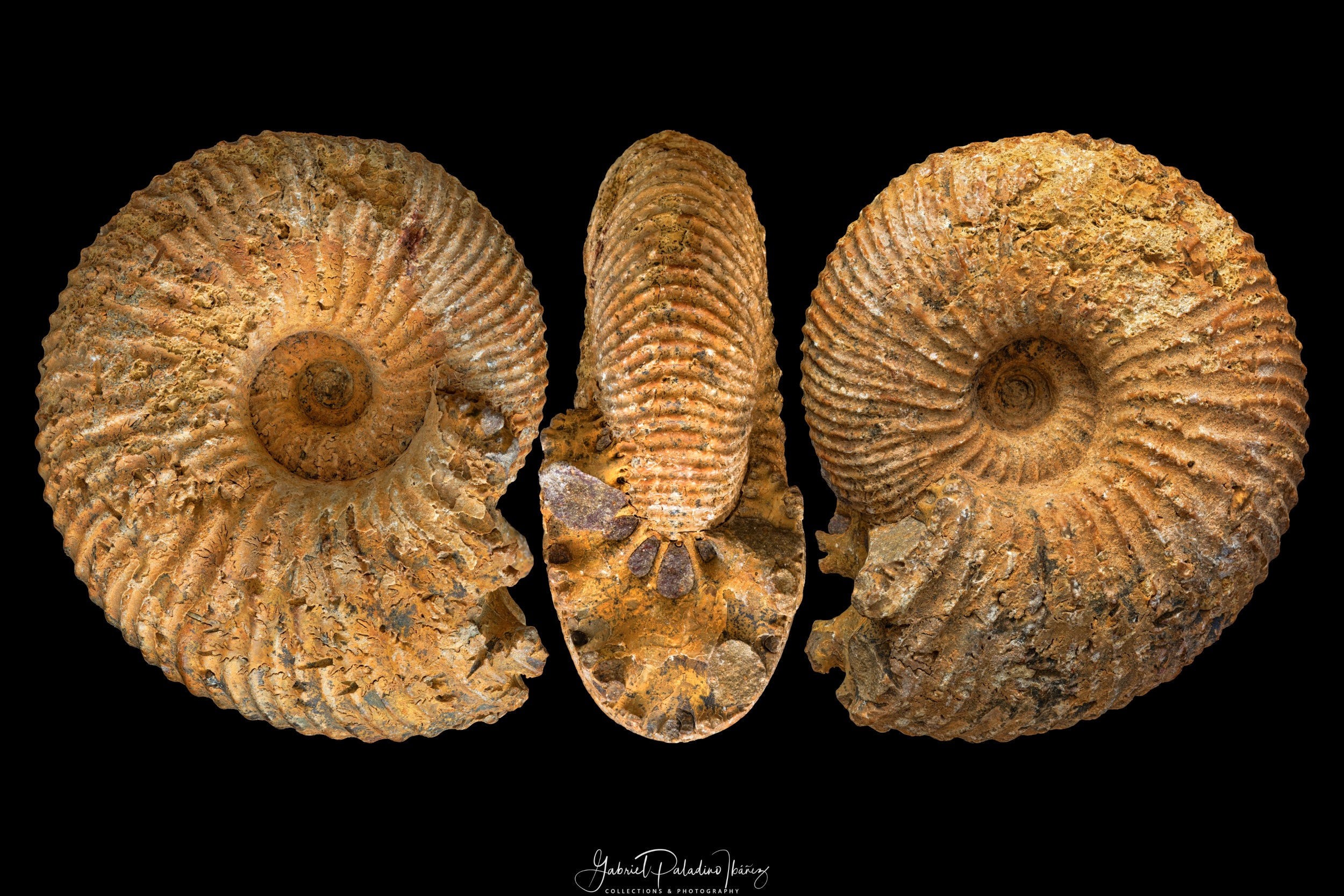
Epimayaites is a genus of ammonites from the Late Jurassic, specifically the Oxfordian stage, approximately 163 to 157 million years ago. Its fossils are found in the marine limestones and marls of southwestern Madagascar — one of the richest Oxfordian ammonite sites in the Indian Ocean region. Specimens of Epimayaites are widely used by geologists to date and correlate rock layers of this age.
The shell is moderately tightly coiled, with a narrow central opening and a whorl section that is taller than it is wide. The ribbing is dense and fine, with primary ribs originating near the inner edge of the shell and sweeping forward across the outer surface. Like all members of the subfamily Mayaitinae, this genus is known exclusively from rocks deposited around the ancient Indian Ocean, and likely showed differences in size or form between males and females, though this aspect of its biology remains poorly understood.
Scientific classification:
Kingdom: Animalia
Phylum: Mollusca
Class: Cephalopoda
Subclass: Ammonoidea
Order: Ammonitida
Superfamily: Stephanoceratoidea
Family: Sphaeroceratidae
Subfamily: Mayaitinae
Genus: Epimayaites
Species: Epimayaites sp.
Era: Mesozoic
Period: Jurassic (Oxfordian, ~163–157 Ma)
Origin: Madagascar (precise locality unknown)
Specimen diameter: 64 mm
The diversity of Epimayaites and related genera in southwestern Madagascar was extensively documented by the French paleontologist Maurice Collignon in his Atlas des Fossiles Caractéristiques de Madagascar (1959), which remains the standard reference for identifying these ammonites. Comparison of this specimen with Collignon’s type material points to a possible affinity with E. transiens (Waagen, 1875), E. axonoides var. rigida Collignon, 1959, or E. aff. falcoides Spath, 1928, though a definitive species identification is not possible without knowing the precise location and rock layer from which it was collected.
Photo Taken: June 05, 2026
High resolution
Flickr Gallery