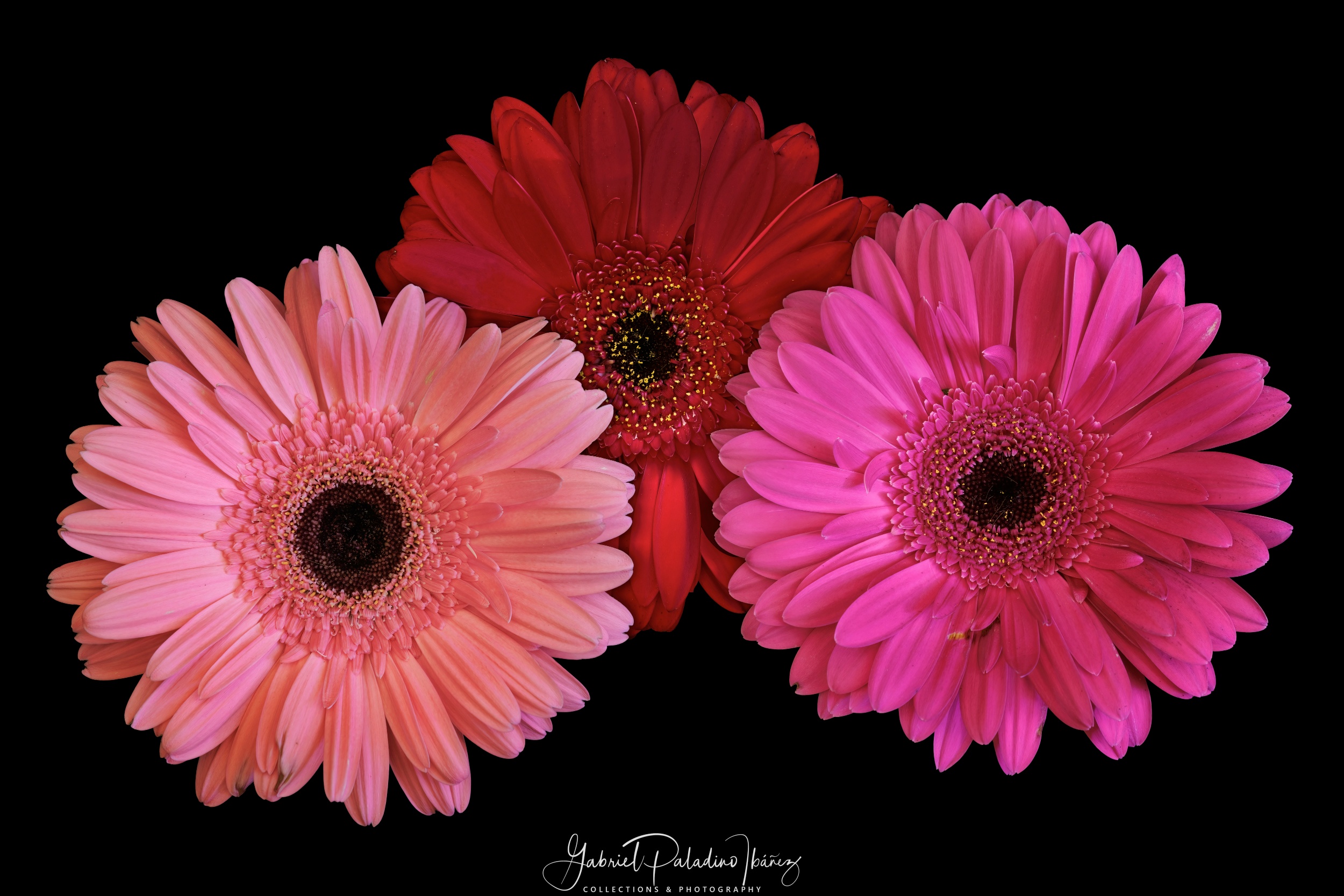
In the Southern Hemisphere, spring has gently arrived, bringing with it the peaceful beauty of blooming flowers and calm, sunny days.
Gerbera, also known as the African daisy, is native to tropical regions of Africa and has been successfully introduced to Latin American and Southeast Asian countries. This species is widely cultivated as a decorative garden plant and as a popular cut flower. The domesticated cultivars are primarily hybrids of Gerbera jamesonii and Gerbera viridifolia, collectively referred to as Gerbera × hybrida.
Scientific classification:
Kingdom:Plantae
Clade:Tracheophytes
Clade:Angiosperms
Clade:Eudicots
Clade:Asterids
Order:Asterales
Family:Asteraceae
Subfamily:Mutisioideae
Tribe:Mutisieae
Genus:Gerbera
Thousands of cultivars exist, displaying remarkable variation in shape, size, and color — including white, yellow, orange, red, and pink. The flower heads (capitula) range from about 7 cm in diameter (Gerbera ‘Mini Harley’) to 12 cm (Gerbera ‘Golden Serena’). The center of the flower is sometimes black, and often a single bloom can have petals of several different colors.
In temperate climates, Gerbera exhibits a bimodal blooming pattern, with flowering peaks in late spring to early summer and again from late summer to early autumn. Although a perennial species, it is often grown as an annual in regions that experience severe frost.
In loving memory of my mother
María Eugenia Ibáñez Somma
💜 December 26, 1950 – October 22, 2025
Photo Taken: October 21, 2025
High resolution
Flickr Gallery
Did you like this post?