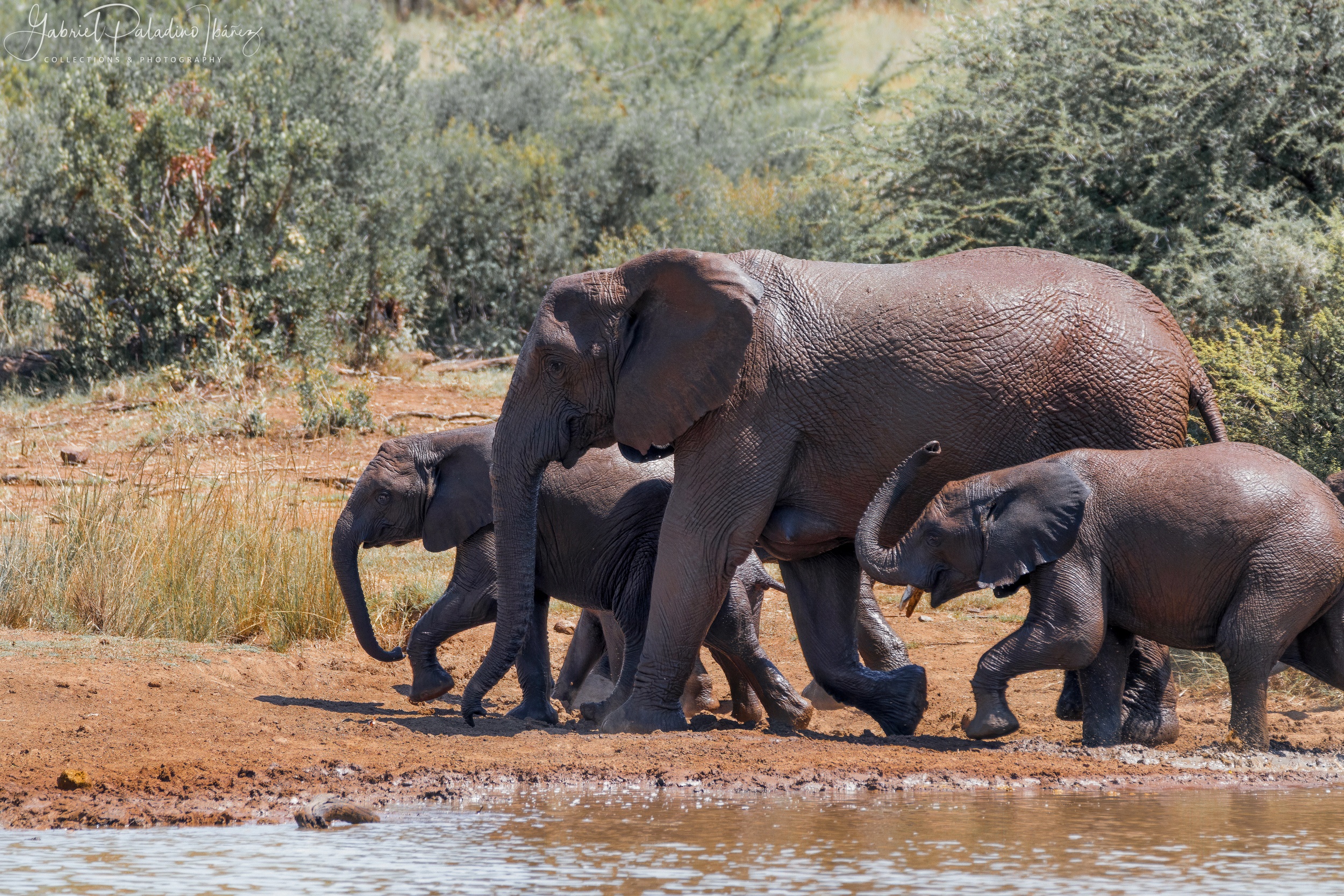
In South Africa’s vast savannas, elephant herds are built on a complex matriarchal structure where an experienced female, the matriarch, guides her family. She leads them to vital resources and passes down critical knowledge of migration routes and dangers, ensuring the group’s survival.
These herds consist of related females and their offspring. Raising the young is a collective effort, with younger females often serving as "nannies." This cooperative system allows mothers to forage and rest while their calves learn essential social behaviors. The elephants’ strong family bonds, deep empathy, and remarkable memory underscore their intelligence and emotional nature, helping them maintain these lifelong connections.
While the image highlights a single family, other related female groups are often nearby, forming larger clans. These clans maintain contact and share key areas like water sources, as their proximity is crucial for the safety and learning of the young.
Loxodonta africana
• African Elephant / African bush elephant / African savanna elephant
• Elefante Africano / elefante africano de sabana
Scientific classification
Kingdom:Animalia
Phylum:Chordata
Class:Mammalia
Order:Proboscidea
Family:Elephantidae
Genus:Loxodonta
Species:L. africana
Mankwe dam, Pilanesberg National Park, North West Province, South Africa
Camera: Canon EOS 77D / 9000D
Lens: Sigma 150-600mm F5-6.3 DG OS HSM | Contemporary
Capture Information:
Focal Length: 347.0 mm
Shutter Speed: 1/500
Aperture: f/5.6
ISO: 320
Photo Taken: March 12, 2018
High resolution
Flickr Gallery
Did you like this post?