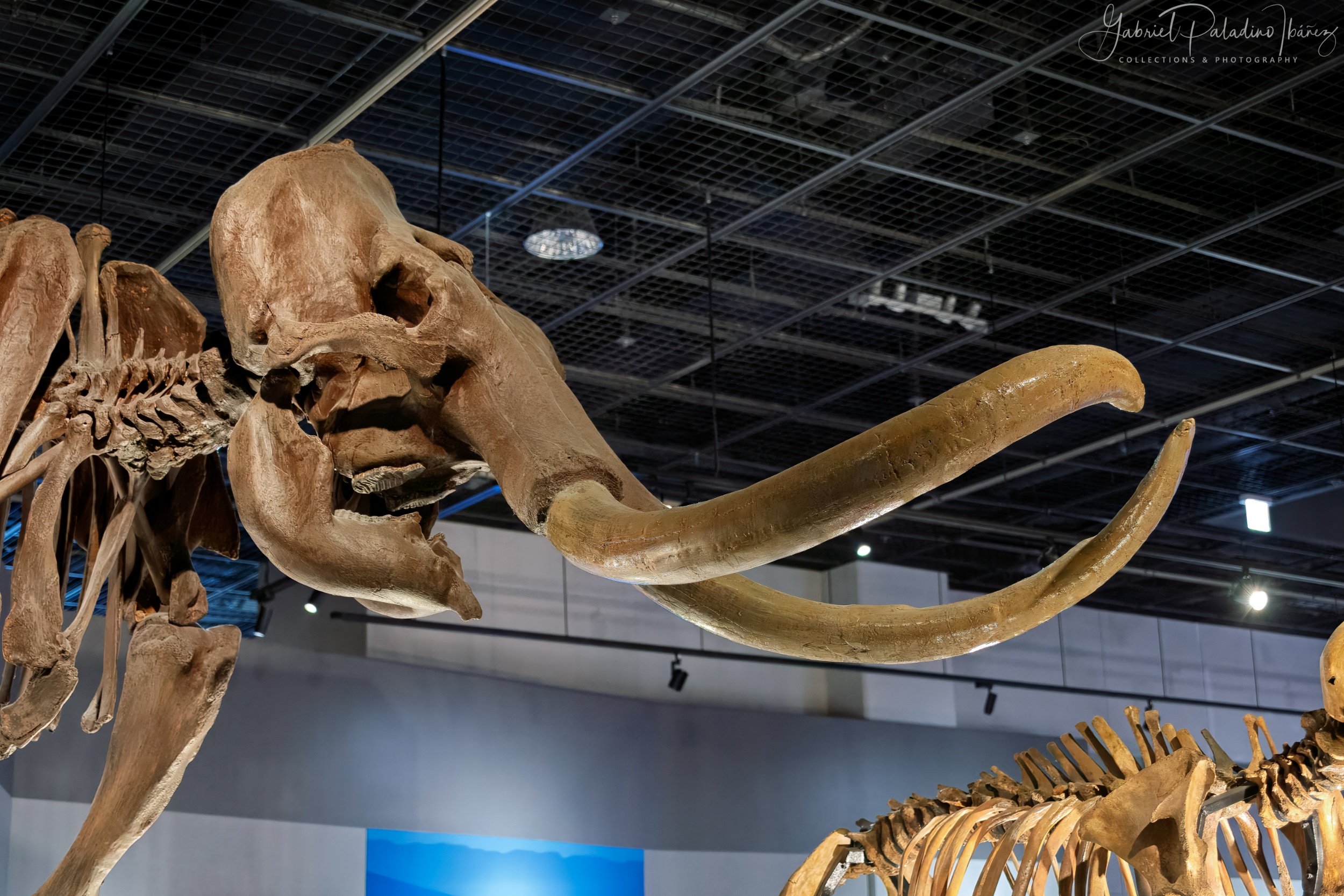
The Gwacheon National Science Museum includes an exhibit on the woolly mammoth (Mammuthus primigenius), presenting a replica skeleton of an adult specimen.
It represents an animal that could reach up to 3.5 meters in length and weigh about 2.5 tons, providing insight into the size and structure of this Ice Age species.
Alongside the reconstruction, TIMA, a young mammoth from Omsk, Siberia, about 7 years old, 1.8 m tall, and with over 80% of its original bones, is shown in a previously taken photograph of mine, displayed here.
• Woolly Mammoth
• Mamut lanudo, elefante lanudo, mamut de la tundra
Scientific Classification:
Kingdom: Animalia
Phylum: Chordata
Class: Mammalia
Order: Proboscidea
Family: Elephantidae
Genus: Mammuthus †
Species: M. primigenius †
The woolly mammoth (Mammuthus primigenius), a close relative of today’s elephants, once occupied the vast cold grasslands of the “mammoth steppe,” which stretched across Eurasia and North America during the last Ice Age.
Well adapted to the freezing conditions of the Pleistocene, it carried a thick insulating fat layer beneath its skin, a coat of long, shaggy hair, and ears smaller than those of modern elephants to limit heat loss.
Adult animals could reach about 3.5 meters in height, while their distinctive tusks—strongly curved and massive—sometimes grew to more than 4 meters in length.
Feeding mainly on grasses, shrubs, and woody vegetation, these large herbivores began to decline roughly 10,000 years ago, a process linked to climatic changes and human hunting, though a few isolated populations persisted on Arctic islands until around 4,000 years ago.
Camera: Canon EOS 800D / Rebel T7i / Kiss X9i
Lens: TAMRON SP 28-75mm F/2.8 Di A09E
Capture Information:
Focal Length: 35.0 mm
Shutter Speed: 1/60
Aperture: f/2.8
ISO: 1600
Photo Taken: April 30, 2025
High resolution
Flickr Gallery
Did you like this post?