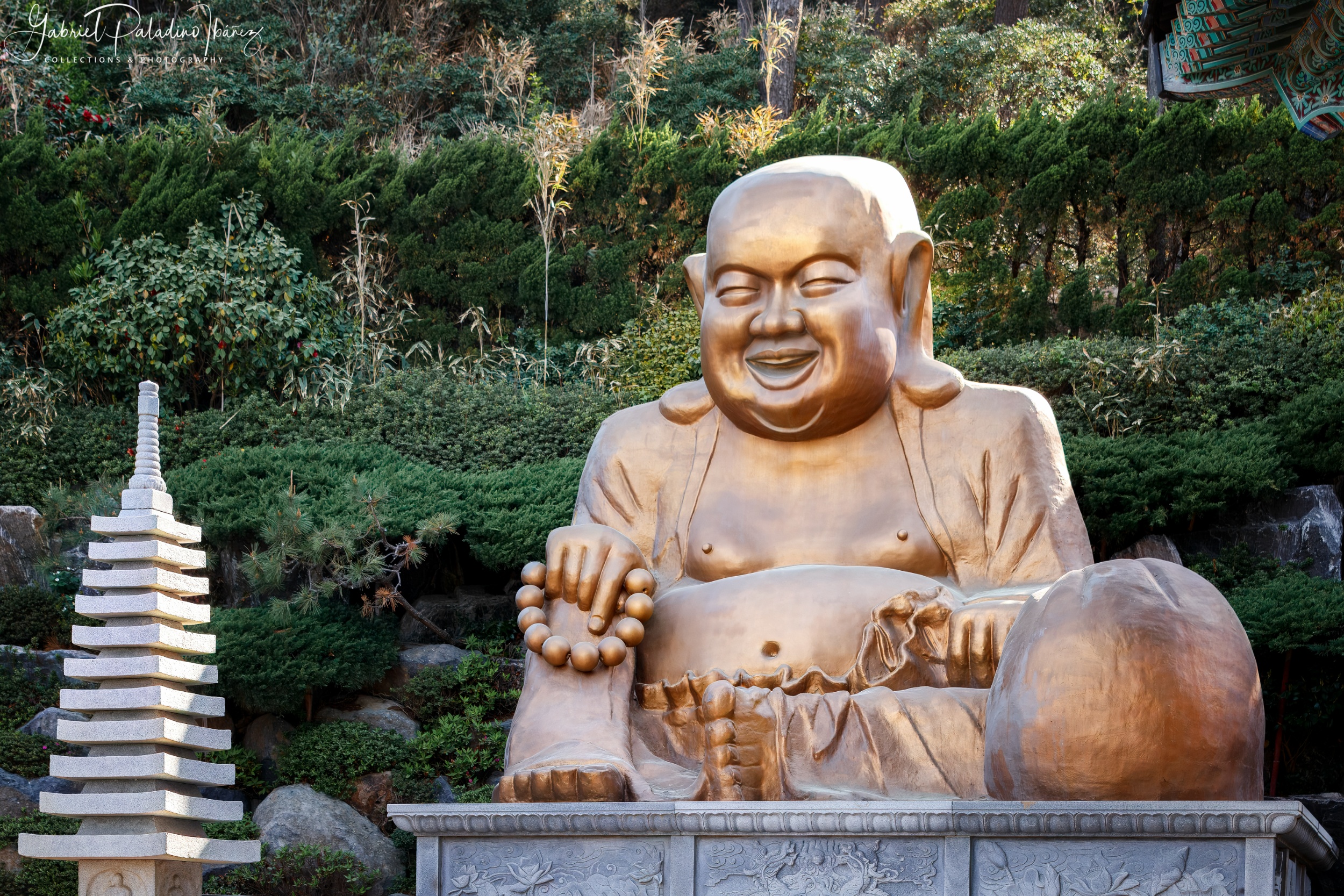
During my visit to the temple, the Laughing Buddha was a particularly eye-catching figure. Known in Korean as Podaehwasang (포대화상), and also widely by his Chinese name Budai, this figure was a real monk who lived in China during the Tang dynasty. He is not a representation of Gautama Buddha, but rather of a deity of happiness and good fortune. The statue’s face reflected a genuine and contagious smile, with round cheeks and a prominent belly that peeked out from under his robe.
His figure symbolizes abundance and prosperity. It is widely believed that Podaehwasang is an incarnation of Maitreya, the future Buddha, who is prophesied to bring an era of peace and joy. The statue held a rosary in its right hand and its characteristic cloth sack in the left—an object that, according to legend, contains treasures and gifts for those in need. His presence at the temple was a constant reminder of the joy and good fortune that Buddhism represents.
Haedong Yonggungsa, Gijang-gun, Busan, South Korea
Camera: Canon EOS 800D / Rebel T7i / Kiss X9i
Lens: TAMRON SP 28-75mm F/2.8 Di A09E
Capture Information:
Focal Length: 33.0 mm
Shutter Speed: 1/100
Aperture: f/4.0
ISO: 100
Photo Taken: April 28, 2025
High resolution
Flickr Gallery
Did you like this post?