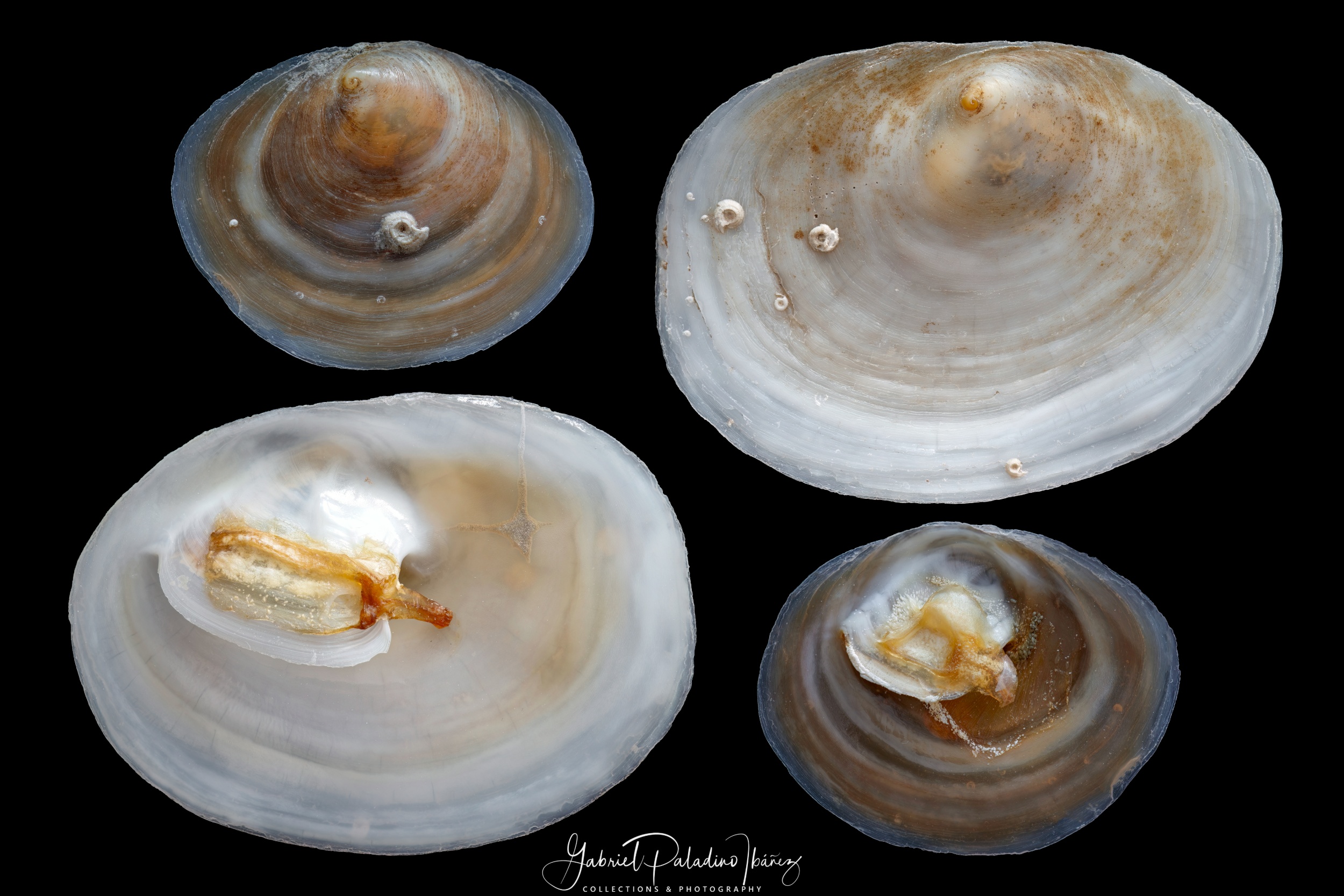
• Eastern white slipper limpet, Walsh’s slippery shell
• ヒラフネガイ
Ergaea walshi is a small marine gastropod, a member of the Calyptraeidae family, commonly known as slipper limpets. Its Japanese name, Hirafunegai, aptly translates to "flat-boat shell," perfectly describing its distinctively flattened morphology.
This limpet’s shell is typically white, smooth, and oval, usually measuring under 3 cm in length. While juveniles may retain a faint spiral, the shell significantly flattens into a low dome as they mature. A defining characteristic, aiding in internal body support, is the thin, calcified septum (or "deck") found on its inner surface.
Residing on sand flats from the lower intertidal to upper subtidal zones, this species forms a commensal relationship with hermit crabs. It often attaches to the inner surface of dead bivalve shells or, more notably, to the interior of large snail shells (like Turbo cornutus) already occupied by hermit crabs. This association is observed with Diogenes and Clibanarius in shallower waters, and Dardanus in deeper environments. The limpet’s flattened shell proves to be a crucial adaptation, minimizing interference with the host hermit crab’s movement and internal space, thereby facilitating their harmonious coexistence.
As a filter feeder, it draws suspended microorganisms from seawater using the ciliary action of its gills.
Like many calyptraeid limpets, this species exhibits protandric hermaphroditism. Individuals begin their lives as males and later transition into females as they grow. This reproductive strategy frequently involves smaller males positioning themselves directly on the shells of larger females—a behavior thought to boost reproductive efficiency by ensuring close proximity for fertilization.
Scientific classification:
Kingdom: Animalia
Phylum: Mollusca
Class: Gastropoda
Clade: Caenogastropoda
Clade: Hypsogastropoda
Clade: Littorinimorpha
Superfamily: Calyptraeoidea
Family: Calyptraeidae
Genus: Ergaea
Species: Ergaea walshi
Found inside a dead Turbo cornutus shell, among marine debris and organic matter.
Dongam Fishing Port, Gijang-eup, Gijang-gun, Busan, South Korea
Photo Taken: June, 2025
High resolution
Flickr Gallery
Did you like this post?