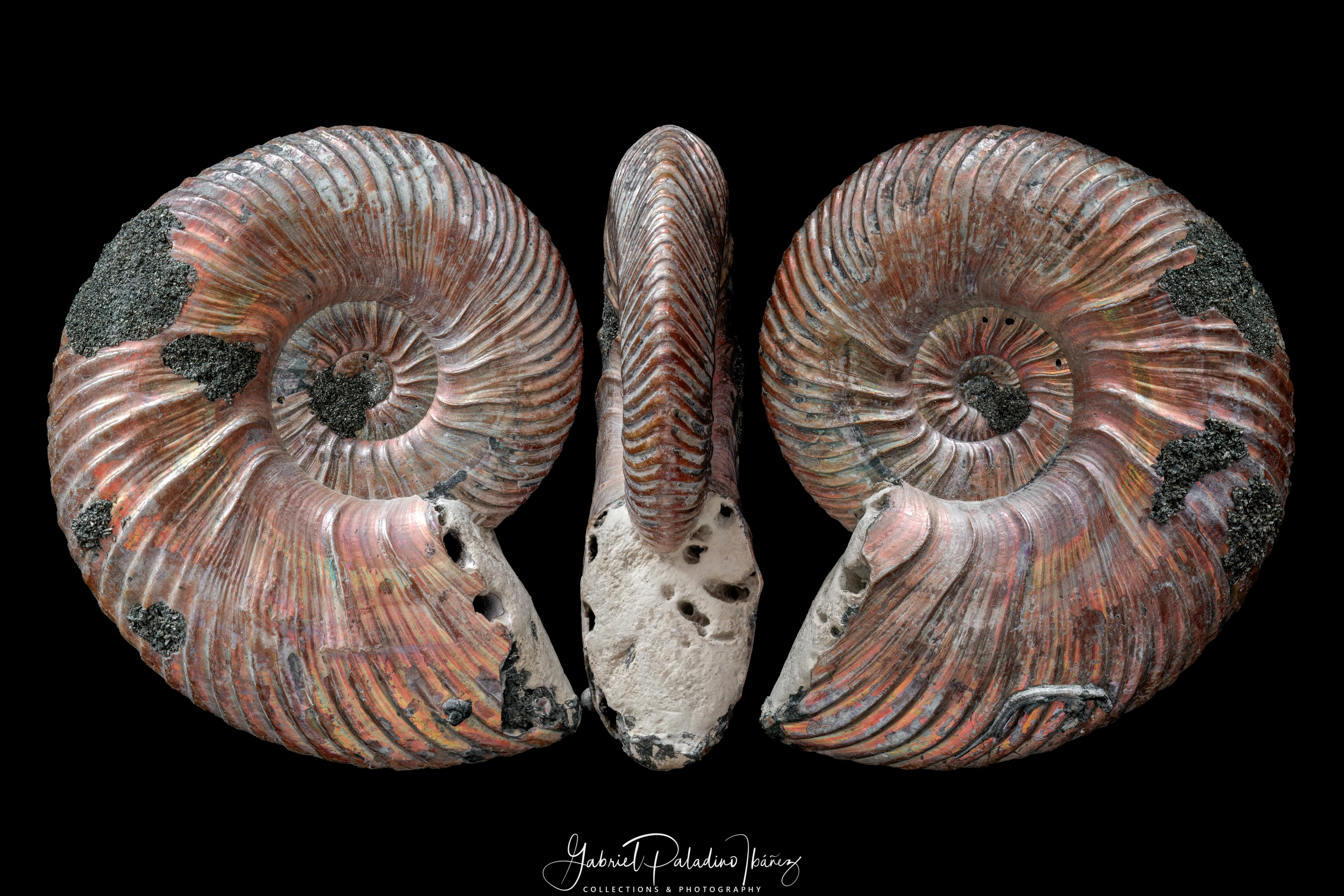
Quenstedticeras is a genus of ammonites from the Late Middle Jurassic, specifically the Callovian stage, approximately 164 to 161 million years ago. Its fossils are especially abundant in the marine clays of the Dubki Clay Quarry, near Saratov, southwestern Russia—one of the most productive and best-preserved Middle Jurassic ammonite localities in Eurasia. These ammonites are valuable biostratigraphic markers of the Lamberti Zone, although the precise species found at Dubki has not been formally confirmed.
The shell of Quenstedticeras is typically moderately evolute, with whorls that are clearly visible in adult specimens. The ribbing is strong and regular, with primary ribs originating at the umbilical shoulder and bifurcating mid-flank before meeting at a prominent keel on the venter. The ornamentation gives the shell a distinctive starburst pattern. Like other ammonites of the family Cardioceratidae, this genus shows clear sexual dimorphism, with larger macroconchs (probable females) and smaller microconchs (probable males), sometimes bearing small lappets.
At Dubki, specimens of Quenstedticeras occur in remarkable abundance and preservation. Most are found as pyritized internal molds within fine-grained laminated clays, deposited in a quiet, low-oxygen marine environment that prevented shell dissolution and favored the growth of iron sulfides. Over a thousand specimens have been recovered, many showing signs of healed injuries, growth deformities, or encrustation by small bivalves—evidence of ecological interactions during the animal’s life.
While many of the fossils from Dubki resemble Quenstedticeras lamberti, the dominant index species of the upper Callovian, their identification remains tentative, pending detailed taxonomic revision.
Scientific classification:
Kingdom: Animalia
Phylum: Mollusca
Class: Cephalopoda
Subclass: Ammonoidea
Order: Ammonitida
Superfamily: Stephanoceratoidea
Family: Cardioceratidae
Genus: Quenstedticeras
Species: Quenstedticeras sp.
Era: Mesozoic
Period: Jurassic (Callovian, ~164–161 Ma)
Origin: Dubki Clay Quarry, Saratov Region, Russia
Specimen diameter: 52 mm
The Dubki site continues to yield important fossil material for biostratigraphic, paleoecological, and taphonomic research. The exceptional preservation allows paleontologists to study not only shell morphology but also paleo-biological interactions, such as predation and epibiont colonization, in Middle Jurassic marine ecosystems.
Photo Taken: July 2025
High resolution
Flickr Gallery
Did you like this post?