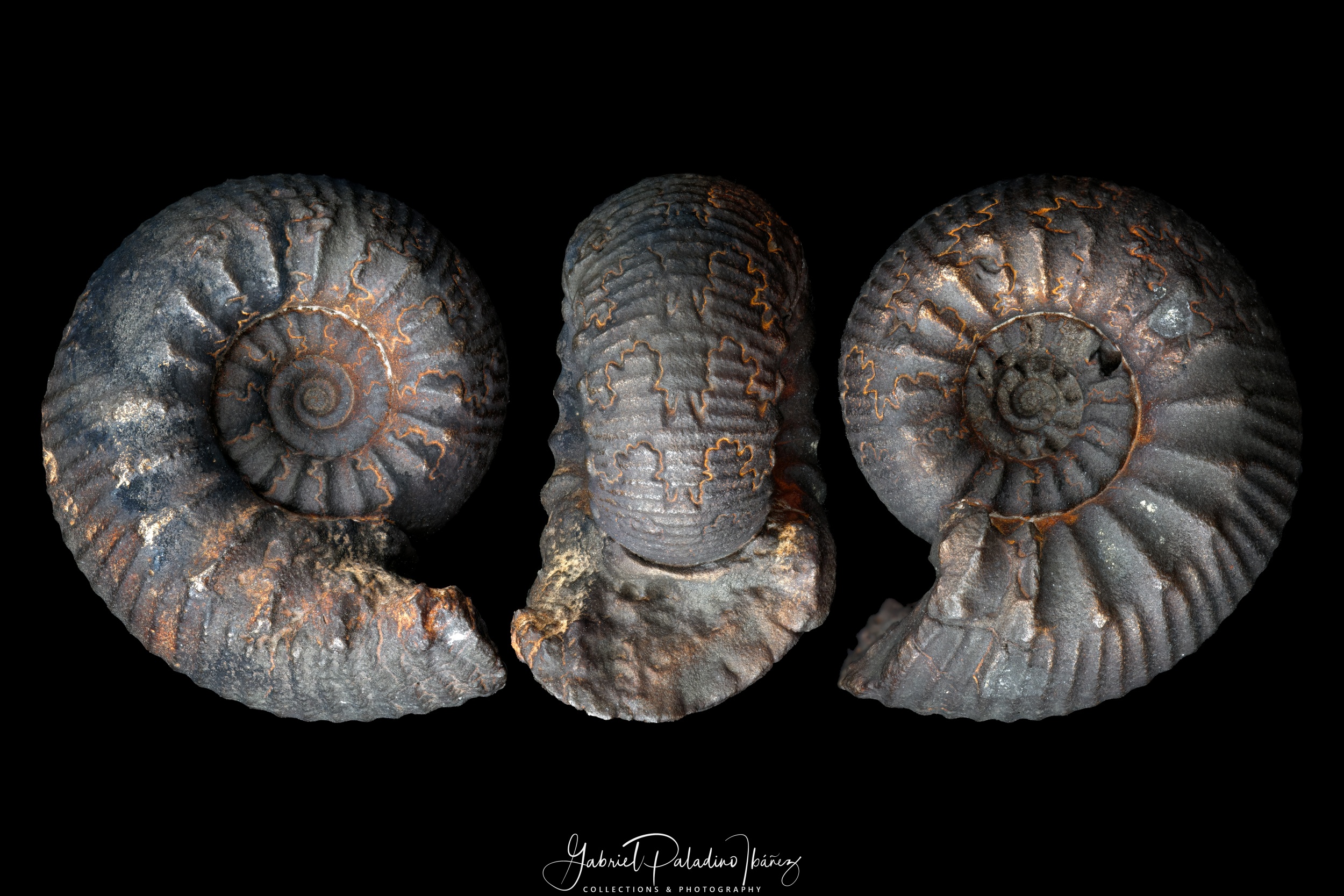
Catacoeloceras is a genus of ammonite that lived during the Early Jurassic, specifically in the Toarcian stage, approximately 183 to 175 million years ago. Its fossils are characteristic of the marine deposits of Millau, in the Aveyron department of France, a classic European locality for Jurassic paleontology. These ammonites are key index fossils, used to identify and date the "Bifrons Zone" of the Toarcian.
The shell of Catacoeloceras is evolute, meaning the inner whorls are clearly visible. It has a distinctive subquadrate (almost square) whorl section and is adorned with strong, straight, and simple ribs that cross the entire flank. The key and most distinctive feature of the genus is the presence of two rows of tubercles or spines on the ventral region (the outer rim), which are separated by a smooth groove.
These cephalopods inhabited the shallow to moderately deep seas of the Tethys Ocean that covered much of present-day Europe. Their fossils in the Millau region are often found well-preserved in marly limestone nodules, sometimes retaining fine details of the shell structure.
Scientific classification:
Kingdom: Animalia
Phylum: Mollusca
Class: Cephalopoda
Subclass: Ammonoidea
Order: Ammonitida
Superfamily: Hildoceratoidea
Family: Dactylioceratidae
Subfamily: Dactylioceratinae
Genus: Catacoeloceras
Species: Catacoeloceras sp.
Era: Mesozoic
Period: Jurassic (Toarcian, ~183–175 Ma)
Origin: Millau, Aveyron, Occitanie, France
Specimen diameter: 16 mm
Photo Taken: July 14, 2025
High resolution
Flickr Gallery
Did you like this post?