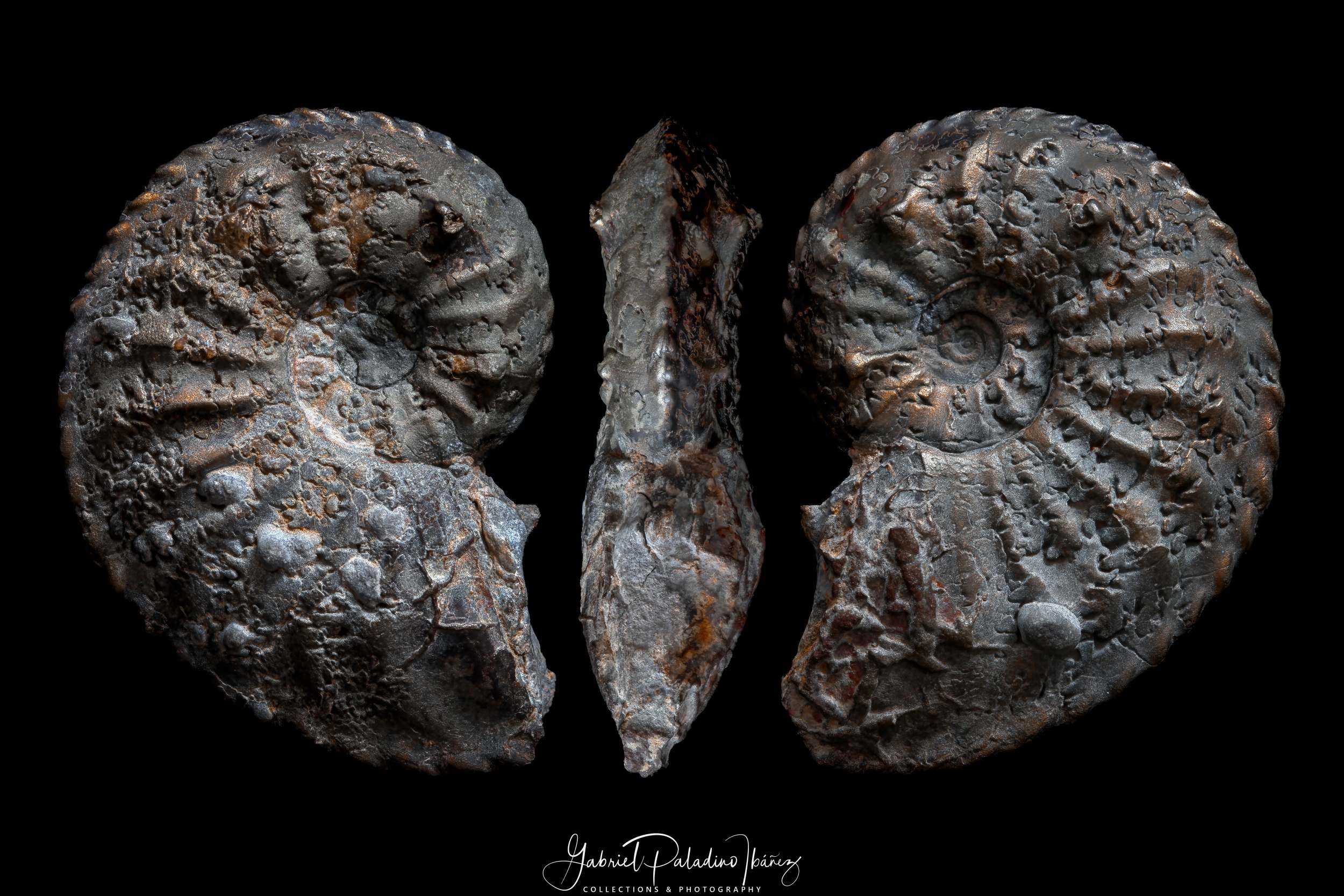
Amaltheus gibbosus is a species of ammonite from the Early Jurassic, more precisely from the Pliensbachian stage, around 190 to 183 million years ago. Due to its rapid evolution and wide geographic distribution, it serves as an excellent index fossil, helping geologists date rock layers with high precision.
Its fossils are found in the marine deposits of Millau, in the Aveyron department of southern France, a region well known for its Jurassic outcrops. These ammonites lived in shallow seas that once covered much of what is now Europe, where they coexisted with other marine fauna such as belemnites, bivalves, and other cephalopods.
The species is recognizable by its compressed, involute shell, with outer whorls largely covering the inner ones. It likely exhibited sexual dimorphism, with larger macroconchs (inferred females) and smaller microconchs (inferred males). The ribs are strong and radial, sometimes ending in rounded tubercles near the ventrolateral area. One of the defining features is the sharp, often crenulated keel that runs along the venter—the outer edge of the shell—without any accompanying grooves. This keel gives the species a streamlined appearance, typical of many fast-moving, nektonic ammonites.
Scientific classification:
Kingdom: Animalia
Phylum: Mollusca
Class: Cephalopoda
Subclass: Ammonoidea
Order: Ammonitida
Superfamily: Amaltheoidea
Family: Amaltheidae
Genus: Amaltheus
Species: Amaltheus gibbosus
Era: Mesozoic
Period: Jurassic (Pliensbachian, Margaritatus Zone)
Origin: Millau, Aveyron, Occitanie, France
Specimen diameter: 35 mm
In Millau, fossils of A. gibbosus are typically found in marl and limestone layers. The preservation is often good enough to show the ribbing, the shape of the whorls, and the ventral keel. Specimens are usually collected from nodules or split bedding planes. While not all are complete, the key morphological traits remain easy to identify.
Photo Taken: July 01, 2025
High resolution
Flickr Gallery
Did you like this post?