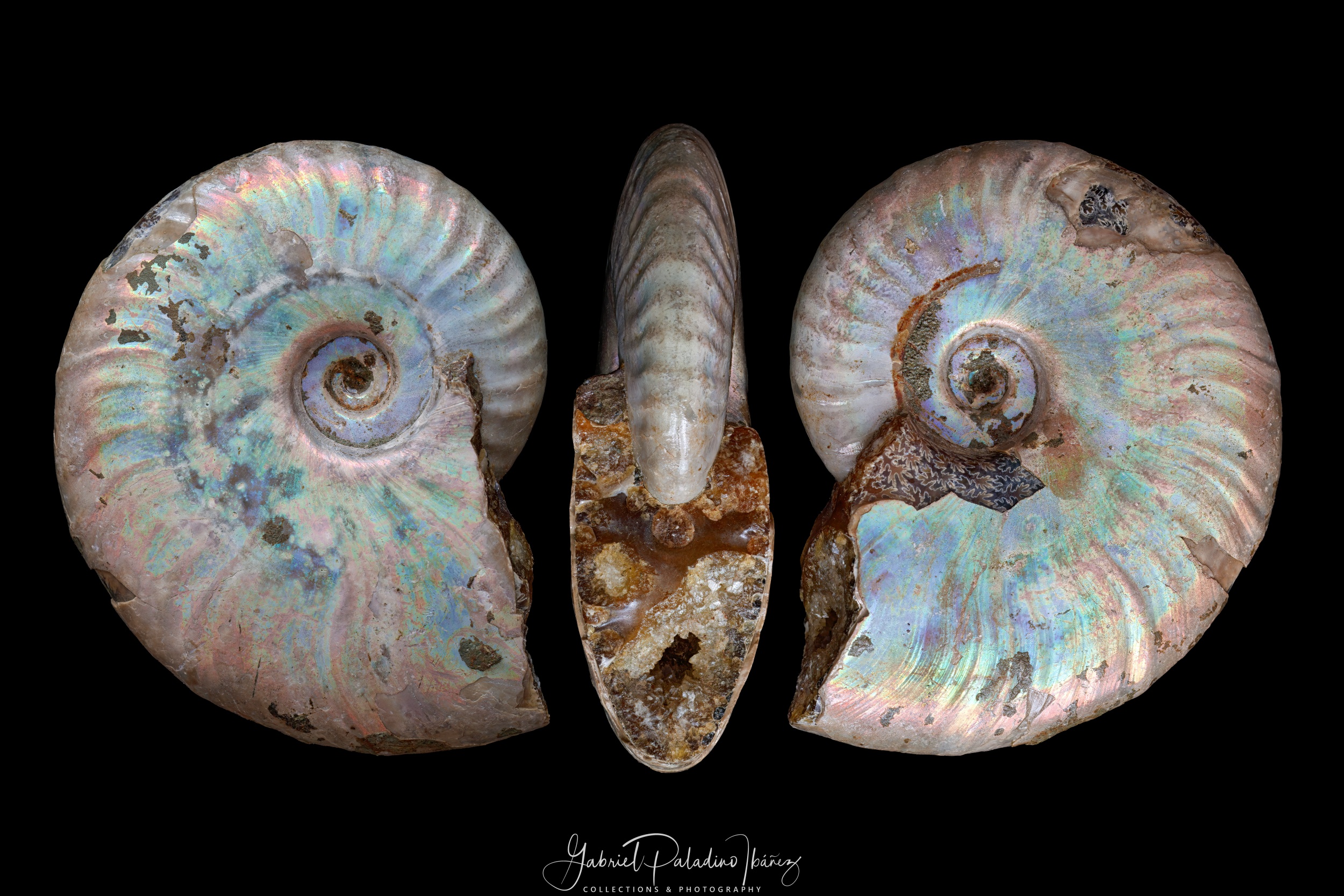
Ammonites are a group of extinct molluscs which somewhat resembled a shelled squid when they were alive.
These ancient sea creatures had tentacles like the modern octopus, and spiral shells like Nautilus creatures.
They first appeared on the fossil record 240 million years ago, in the Triassic Period, and died out 65 million years ago with the dinosaurs during the Cretaceous-Tertiary Mass Extinction Event.
The fossilised remains of these sea creatures are perhaps the most popular fossils on the market today.
This particular ammonite is a member of the Cleoniceras species of ammonites.
Scientific classification:
Kingdom:Animalia
Phylum:Mollusca
Class:Cephalopoda
Subclass:Ammonoidea
Order:Ammonitida
Superfamily:Hoplitaceae
Family:Hoplitidae
Genus:Cleoniceras
Species: Cleoniceras sp.
Era: Mesozoic
Period: Cretaceous
Origin: Mahajanga (Madagascar)
Description: Iridescent Ammonite. No restorations, 100% natural.
Cleoniceras is a rather involute, high-whorled hoplitid from the Lower to basal Middle Albian of Europe, Madagascar, and the Transcaspian region. The shell has a generally small umbilicus, arched to acute venter, and typically at some growth stage, falcoid ribs that spring in pairs from umbilical tubercles, usually disappearing on the outer whorls.
Cleoniceras is included in the subfamily Cleoniceratinae.
Photo Taken: May 05, 2024
Did you like this post?