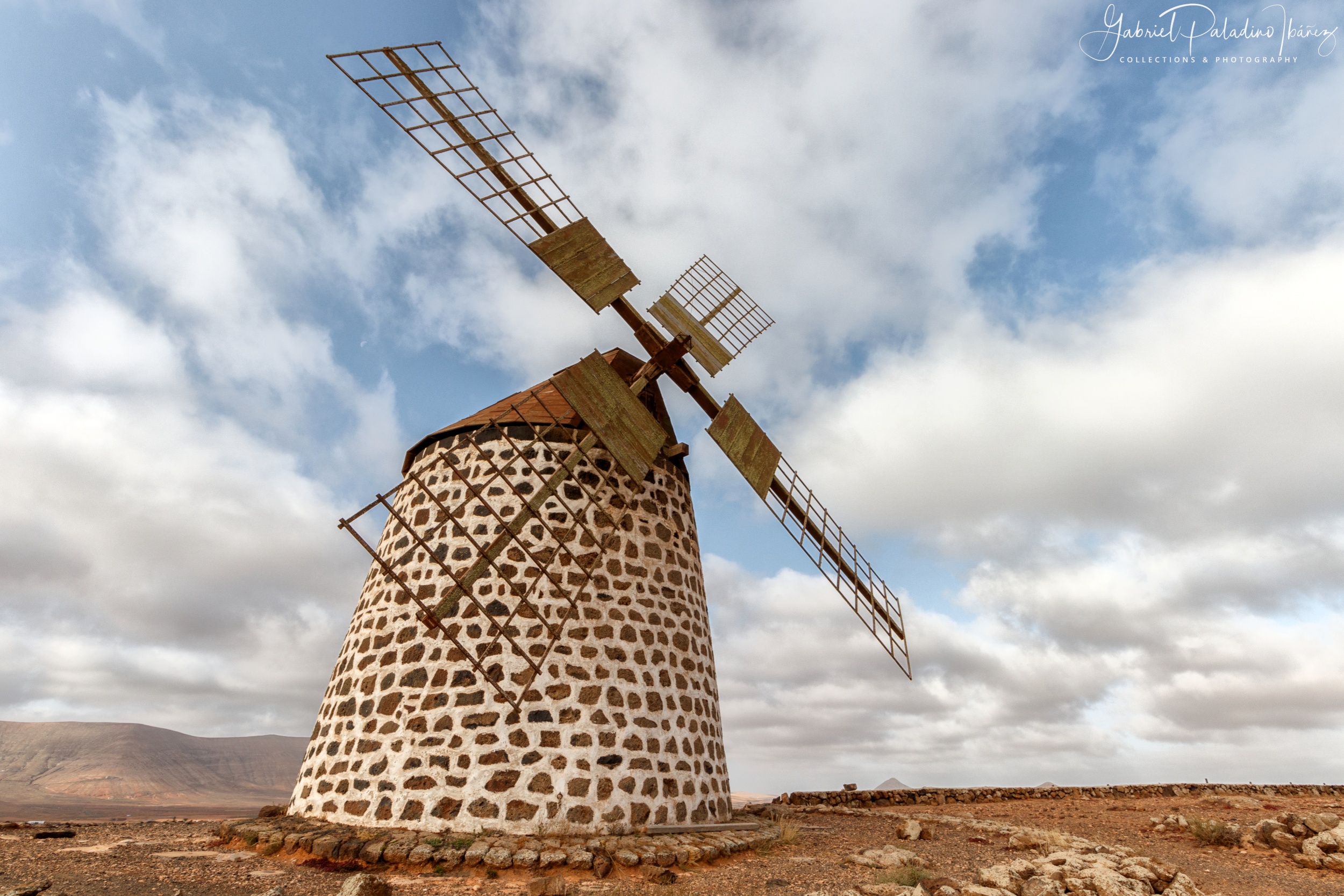
Windmills have become part of the Canarian landscape, silent witnesses of a past in which they played an important role in the economy of the islands. In the case of Fuerteventura, they existed profusely because this typology is developed mainly in arid or desert regions, taking the wind as a source of energy, to make up for the lack of water currents. To this contributed the almost permanent presence of air currents in the islands and the orography of the island, characterized by vast plains only “interrupted” by these peculiar constructions.
Their typologies are made up of two very different types, but one of them predominates numerically. The most abundant is defined by an architectural structure of flat circular plant, with truncated cone shape made of masonry, topped by an irregular conical or pyramidal wooden roof of which one of its parts is open to give exit to the axis of the blades. The interior is divided into two floors, with access to the upper floor by an interior staircase, in some cases, or exterior, in others. The other typology, of which there are fewer examples, is defined by a quadrangular building, on which rises a tower made with a framework of wooden railings, which supports the blades. In the center of the tower descends an axis that connects the gearing of the blades with the stones.
La Oliva, Fuerteventura, Islas Canarias
Photo Taken: April 13, 2023
High resolution
Flickr Gallery
Did you like this post?